


A couple of years ago, a lot of people were very surprised to read that the richest man in the world was no longer Bill Gates, Elon Musk or Jeff Bezos, but Bernard Arnault, whose company—LVMH—had just reached a market cap of half a trillion dollars. LVMH was the first company in Europe to reach this valuation and, shockingly, it wasn’t a tech company but a house of luxury brands.
Since then, it seems journalists can’t stop writing about the secret formula behind the luxury industry’s success, and LVMH’s success specifically.
All sorts of platitudes have been written about the usual critical factors: high quality, attention to detail, heritage, impeccable customer service, etc. For some, what you really, really need is a great brand story. For others, everything revolves around the brand experience.
While I have certainly advocated for these factors in the past—I wrote a column for Luxury Briefing magazine between 2004 and 2014—today I can’t help but feel like most of the analysis I’ve been reading these last few years is just beating around the bush.
Why?
Because the factors don’t work in isolation. Between story and experience, for example, it makes no sense to choose one. You must work on both, because they feed into each other: the experience frames the story, the story weaves meaning into the experience. Together, they create the emotional resonance you need to achieve your true objective.
So, then, what is your true objective?
Desirability, of course. Desirability is the key to generating deep value.
Here is Bernard Arnault himself, talking about desirability being his prime objective a few years ago: "L’objectif principal n'est ni la croissance, ni le profit, mais le développement de la désirabilité." Our principal objective is neither growth, nor profit, but the development of desirability.
Desirability is a weird thing for your business to hang its coat on, isn’t it?
To start, it’s impossible to measure, which makes it a very difficult topic in any board meeting or shareholder meeting, despite everyone knowing exactly how they feel when desire strikes their heart. It’s the most compelling force in the universe.
So, perhaps we can make a better case for it by analysing its constituent parts. The first part we will call “externally-driven desire”, the second “internally-driven desire”.
Externally-driven desire
Let’s borrow a concept from René Girard: mimesis. Simply put, humans are copying machines. We learn everything by copying those around us. The fact alone that you and I are communicating in the same language is a result of this: humans are born and, by copying the other humans talking around them, start talking themselves. Gibberish at first, then “mama” and “dada”, then the rest.
According to Girard, this mimetic aspect of our nature answers some of the most difficult problems for us. For example, the problem with free will is that you have to figure out what your will actually is. What is it that you want? The solution is written in our evolution as copying animals: we want what others want. Which others? The others we most want to be like.
Mimetic desire is the catalyst of both friendship and enmity. Consider two teenage girls who have grown up next door to each other. They’ve been best friends since they were little, played the same games together, read the same books, listened to the same boybands, etc.
Their desires mimic each other. Sometimes one of them will desire something, which will lead the other to copy that desire, which in turn will confirm to the first one that her desire is correct, etc. People might even laugh about how similar they speak, how they always know what the other one is going to say, etc.
The problem starts, of course, when one of them desires something of which there is only one. A boy in school, for example. Scarcity appears: there is a greater desire for something than the world can produce.
If one of the girls gets to satisfy her desire, this will create a source of envy, resentment, betrayal, conflict. The very force that brought them together, that made them one, now drives them apart. At best (or worst, depending on how you feel about these things…) the girls will become frenemies, spending the rest of their lives trying to one-up each other.
To throw this back into the luxury context, this is how one woman will get on Hermès’s waiting list for a Birkin bag, while the other woman will pay three times the price to skip the waiting list via a third-party broker and purchase the 2023 limited edition ostrich leather model. This will cause the first woman to tell her boyfriend something along the lines of “she didn’t even know about that bag until I told her about it!”
With these words, she will have swapped her standards—and her ensuing desires—for something she believes the other will never have. Notice that, in any scenario, choices are being made reactively, driven by external factors. So, now, let’s look at the internal factors.
Internally-driven desire
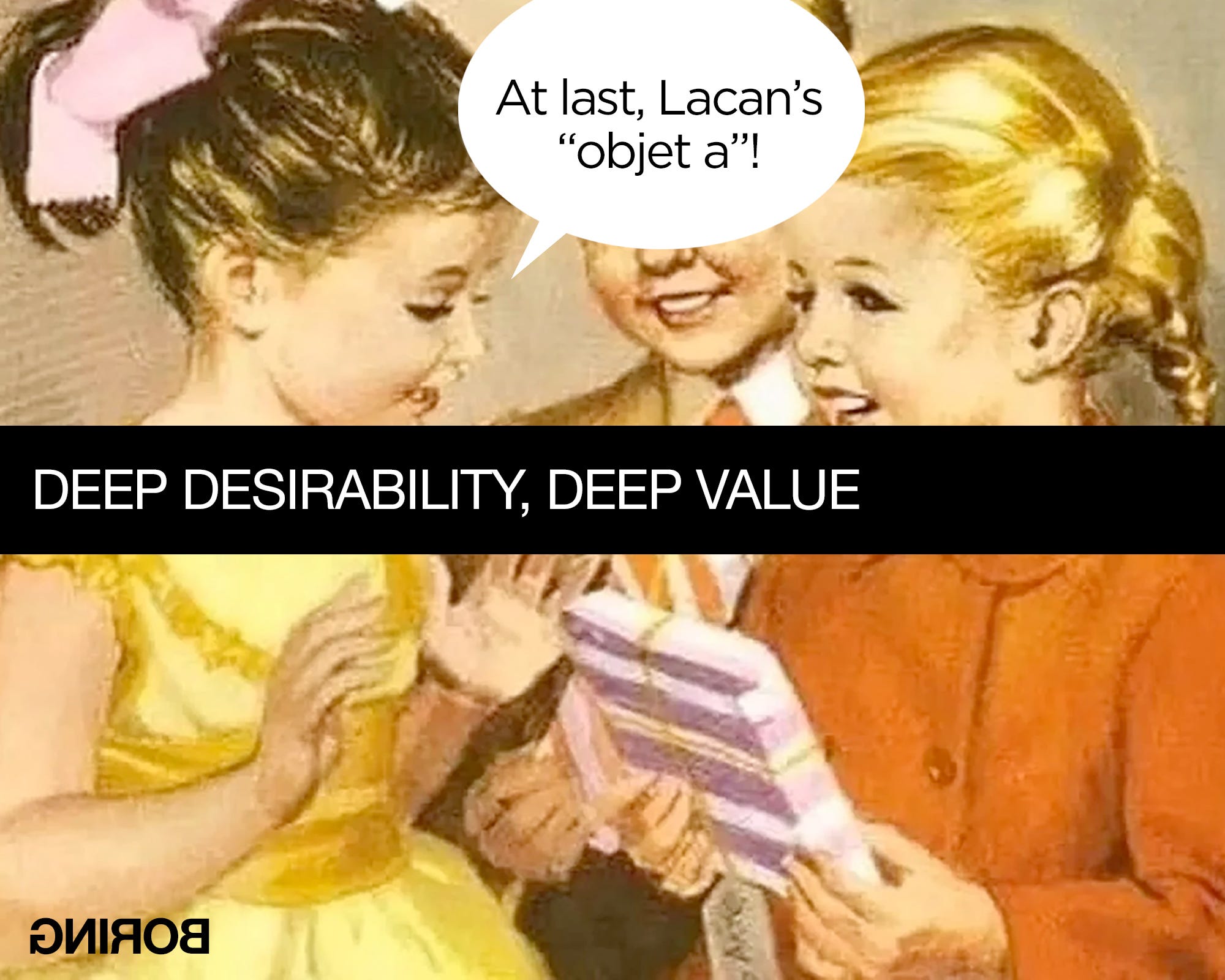
Here, we’ll borrow a concept from someone who spent a good 20 years of his life writing about the psychology of desire: Jacques Lacan. What he referred to as “objet a” is the ever-longed-for-and-never-found object (or rather, object-cause of desire) that we feel a sense of loss and nostalgia for, believing we once had it when we were in the state of “jouissance” (ecstasy or bliss) as babies in our mother’s arms, before submitting to language, articulated thoughts, and the messy business of being human.
The “objet a” (pronounced “objet petit a”) is the ineffable object-cause that causes our attention to fall onto something which then becomes the object of our desire. Over the course of our lives, we project that desire onto all kinds of objects and people, believing them to have something special about them that we cannot put our finger on. Quite literally, what we mean when we say that someone has “a certain je ne sais quoi”.
There’s a quote attributed to André Breton that expresses this perfectly: “All my life, my heart has yearned for a thing I cannot name”. And, since we are seeking an ineffable and impossible object, the more objects we consume that promise to be it—but are not it—the more we desire the real it, projecting our “objet a” onto other objects of desire.
Interestingly, this eternal chase produces in itself a kind of “jouissance”, different to the original “jouissance” we believe to have experienced at the maternal body, which Lacan calls “surplus jouissance”. If you’ve ever heard older wealthy people talking about how they loved becoming rich much more than being rich, that’s probably what they’re referring to, because it’s as close to self-actualisation as you’re going to get in a material world.
Of course, if you think about it, the nostalgia they have for it is as illusory as the “objet a”: it was never there in the moment itself! Their memory put it there later on.
Real, Symbolic and Fantastic
Now, how does “objet a” actually inform us about desirability? Well, one crucial aspect to it is that Lacan places it at the intersection in the Venn diagram of Real, Symbolic and Fantastic. This in itself gives us an idea as to the reason luxury brands have managed to grow so much over the past half century.
Put simply, it’s cinema.
Our ability to experience fantasy (rather than just, well, fantasise about it) has grown ever more powerful and sophisticated over the past 70 years or so. As a result, our “objet a” seems much more “actualisable” to us, since we actually experience some form of it when we watch movies.
In this respect, notice how little was written in the press about Bernard Arnault’s acquisition of the CAA talent agency, when it really seems quite straightforward: film will be the way for LVMH to sustain the relationship between its luxury brands and the public’s “objet a”. In Gucci’s La Famiglia, we spoke about Cerruti’s and Saint Laurent’s love relationship with film. This is what that relationship looks like when it’s taken to the next level and becomes a core business strategy.
Once you start thinking of the film industry as an industry that actualises our fantasies—bringing them into the symbolic world and making them part of the fabric of our collectively shared reality—it becomes quite obvious that its semantic codes, its narrative structures, its archetypes, all serve to feed our desire.
Put simply, if you want your luxury brand to resonate on an emotional level with the public, film is where you should look for guidance.
So, there you have it: a little analysis of desirability for your brand concept to tap into. Hopefully, it will help you put your customer’s desires first when working out how to develop your brand.