


Many years ago, I had a Greek friend who looked like Jack Nicholson. His friends joked about it sometimes. We called him Jack Nikolopoulos.
A few years later, I was directing a campaign for Titanic and, browsing through the pictures, it occurred to me that my friend Rachael looked just like Kate Winslet.
A funny thing happens to people who look like famous actors: they start behaving just like them. My Greek friend ended up wearing the same woolly hats as Jack Nicholson. And Rachael, well, Rachael went “full Rose” after seeing Titanic: hair, clothes, mannerisms, the lot.
Why do I mention all this?
Because they’re examples of mimetic desire, which is such a powerful brand marketing tool, it can turn an obscure brand into a global sensation the moment a celebrity is seen with it.
However, if you’re working in this sector, watch out! You, too, are a ball of mimetic desire! So, fight with all your might your own desire to copy your cool competitors.
And the one thing you should avoid like the plague is 𝘢𝘸𝘢𝘳𝘥𝘴. Why? Because awards are designed to fan the flames of desire to copy your peers.
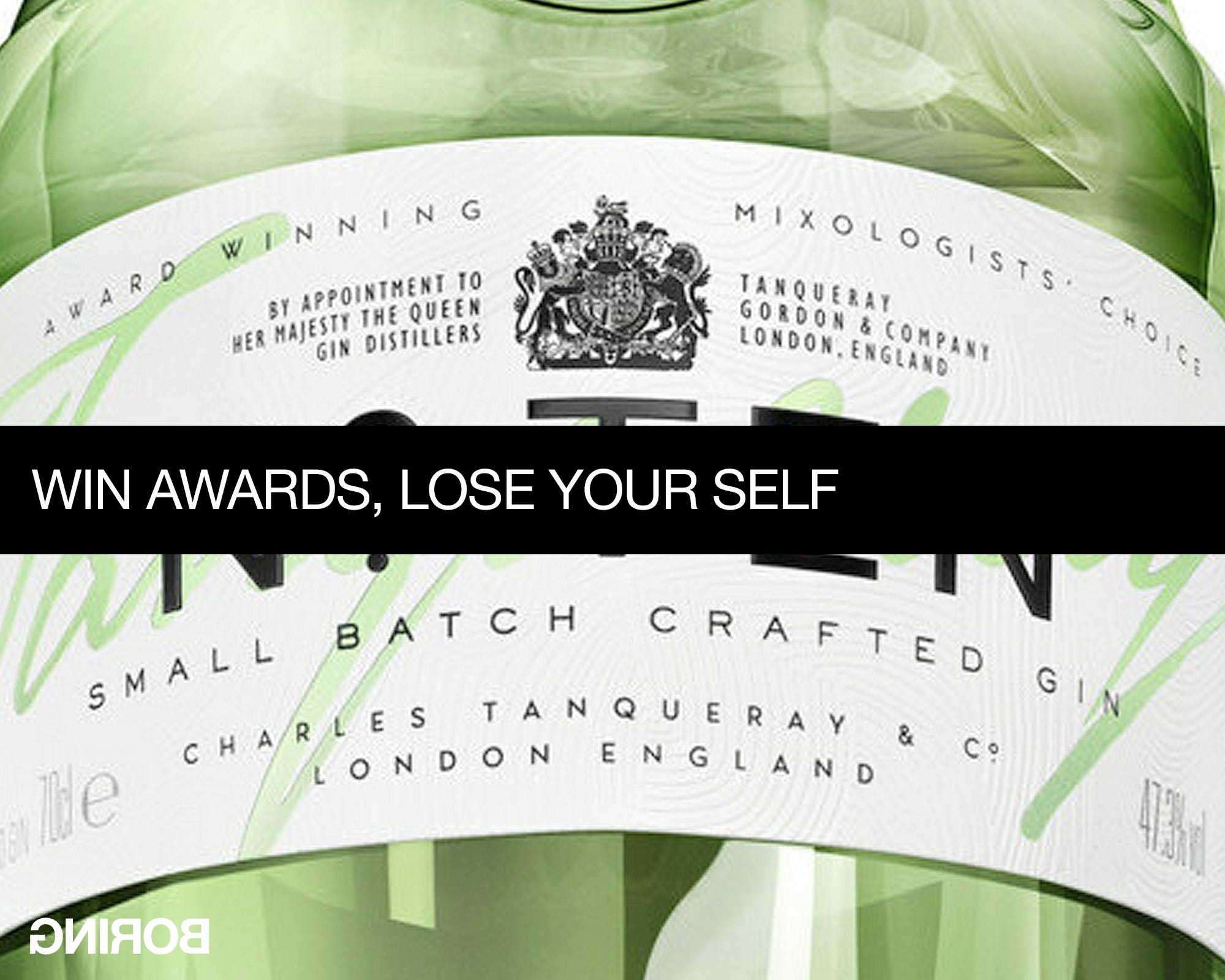
Last month’s Creative Review award given to Tanqueray is a perfect example of this.
Tanqueray Nº Ten was originally a brilliant idea by David Gluckman (better known for his work on Bailey’s Irish Cream, Le Piat d’Or, Aqua Libra, etc.). It had a clear, ownable differentiator: fresh ingredients. Not dried juniper. Fresh. Not dried citrus peel. Fresh. It was simple, specific, and you could build a brand on it.
Then the market changed. Barriers to entry fell. Small brands exploded, and their smallness made them cool.
Pretty soon, every spirit marketer from LA to London discovered the magic words "small batch" and "crafted". Hundreds of spirit brands ended up writing them on their labels. They became clichés. And clichés—as we never tire of saying—are the conceptual equivalent of commodities. No differentiation, no brand value.
So, let’s see if you can guess what Nº Ten now has on its label?
“Small batch crafted gin”.
Of course.
It’s like watching someone trade a tailored suit for a conference hoodie because everyone else is wearing one.
But wait, it gets worse. Tanqueray Ten are clearly dropping the distinctive Tanqueray name and styling in favour of “Nº Ten”, betting on cool people saying “make it a Ten” to their bartenders. To get an idea of how insane this is, imagine Coca-Cola Zero dropping the Coca-Cola from their name and betting on “make it a Zero”.
Now, for the truly frustrating part... If Tanqueray really wanted to own the “small batch” concept, they only needed to remember why they chose the number 10 in the first place: their fresh citrus is distilled in the 10th pot still at the distillery, which is affectionately named... TINY TEN! So, Tanqueray could have owned the “tiny” concept in the consumer’s mind. If you really like “small batch”, tiny is the smallest a batch can get!
Greatness is simple, but not easy: Stop copying. Stop chasing peer validation. Find your true self instead, and then be it on purpose.