


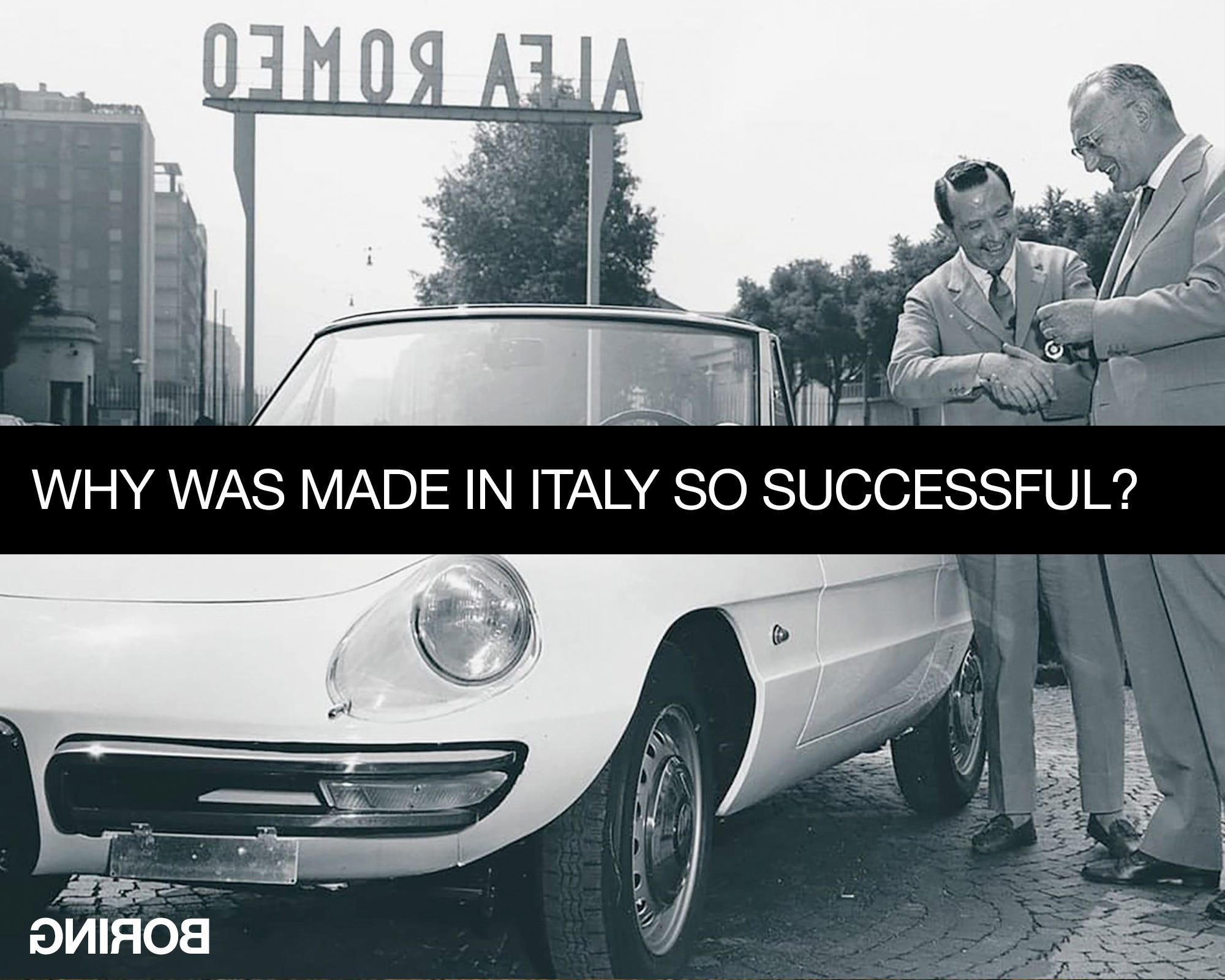
Whenever I talk about the “Made in Italy” brand, people are surprised by the idea that the original mission for Italy’s Ministry of Culture was to serve as the foundation for what would today be termed its nation brand. We tend not to think of our culture as a deliberate construct. It’s something that’s just… there.
So, let’s go back 50 years to look at Italy’s nation brand development.
Back in the 70s, consumers had a very different idea of Italy than they do today. Less Verdi and Versace. More mafia and mummy’s boys. Less Fellini and Ferrari. More Brigate Rosse and bicycle thieves.
Following the theory that everything economic and political is “downstream” from culture, a project was set up to position Italy as the birthplace of everything that is beautiful in Western civilisation.
On this basis, the Ministry of Culture was created in 1974—six years before the launch of the “Made in Italy” brand. During those six years, the desirability of Italy itself was developed through a number of cultural programmes, all connected to each other by the simplest brand concept: 𝗹𝗼𝘃𝗲.
You can still sense the impact of this today when you see, for example, how Top Gear talks about Alfa Romeo. Every other car is qualified by numbers: torque, top speed, horsepower, acceleration... Then they get into an Alfa, turn on the opera music, and talk about passionate love.
But it’s not only passionate love we’re talking about. Italy is a country of family-run companies, so one tangent became “love of family”, manifested in products we’re proud to put our family name on. Italy is a country of food and agriculture, so another tangent became “love of the land”, manifested in the food we cook from local ingredients.
To push the latter, TV-programmes like “Linea Verde” were created: every Sunday, a TV crew would visit small villages to interview farmers on what they were growing, and farmers’ wives on what they were cooking.
These programmes were initially created because the Ministry of Culture had a very small budget, so they had to piggy-back and do the equivalent of brand collabs with other ministries; the Ministry of Agriculture, in this case. Which is a very interesting way to start up that I don’t think new brands think about enough.
But they quickly realised that the way to your heart is through your stomach (which explains why Artusi’s 19th century cookbook united Italians more than any political campaign). So, food took on a very central role in the nation branding project. After all, we all love our mothers and, when we are born, our food literally comes from her. It’s a very profound relationship. If you transpose “love for your mother” for “love for the motherland”, you can easily see the impact that food can have on the Italian identity, and the power with which it can be expressed abroad. It’s no coincidence there are more Italian restaurants in the world than anything else, and that basic Italian ingredients are to be found in kitchens around the world.
What’s interesting about all this is that, over the decades, this simple brand positioning has manifested itself in ever more complex ways to love Italy, each riding a slightly different tangent of the original concept. And then, of course, there are the countless brands all expressing it in their own way, with their own aesthetics. For every product in the world, there’s an Italian brand that makes it with love, and the list is long, long, long. Just running down the alphabet… Abarth, Alessi, Alfa Romeo, Aqua Panna, Arena Sport, Ariston, Armani, Barilla, Benelli, Benetton, Beretta, Bertolli, Bialetti, Bottega Veneta, Brembo, Brunello Cuccinelli, Bugatti, Bvlgari, Calzedonia, Campari, Carpano, Cerruti, Cinzano, Diadora, Diesel, Disaronno, DoDo, Dolce & Gabbana, Ducati, Elisabetta Franchi, Ellesse, Etro, Fendi, Ferragamo, Ferrari, Fiat, Francesco Rana, Gaggia, Gianfranco Ferré, Giovanni Rana, Gucci, Illy, Italdesign, Kappa, Lamborghini, Lancia, Lavazza, Loro Piana, Luisa Spagnoli, Malaguti, Martini, Max Mara, Miu Miu, Montegrappa, Moto Guzzi, Natuzzi, Nonino, Nutella, Olivetti, Perugina, Piaggio, Pininfarina, Pirelli, Pomellato, Pucci, Prada, Ramazzotti, Riva, Roberto Cavalli, Saclà, Sanpellegrino, Segafredo, Smeg, Schiaparelli, Stefanel, Superga, Tic Tac, Tod’s, Trussardi, Valentino, Versace, Vespa, Zagato, Zanotta, Zanussi, Zegna, …
This may lead some brand analysts to think it’s more complicated than it really is. But the source is still just one concept: 𝗹𝗼𝘃𝗲.
What can we learn from this? Well, let’s think of your company’s brand team as its Ministry of Culture. As complex as the cultural programme may eventually come to be, it still has to start from a simple, resonant, and original positioning. What’s the one word holding your brand together?