


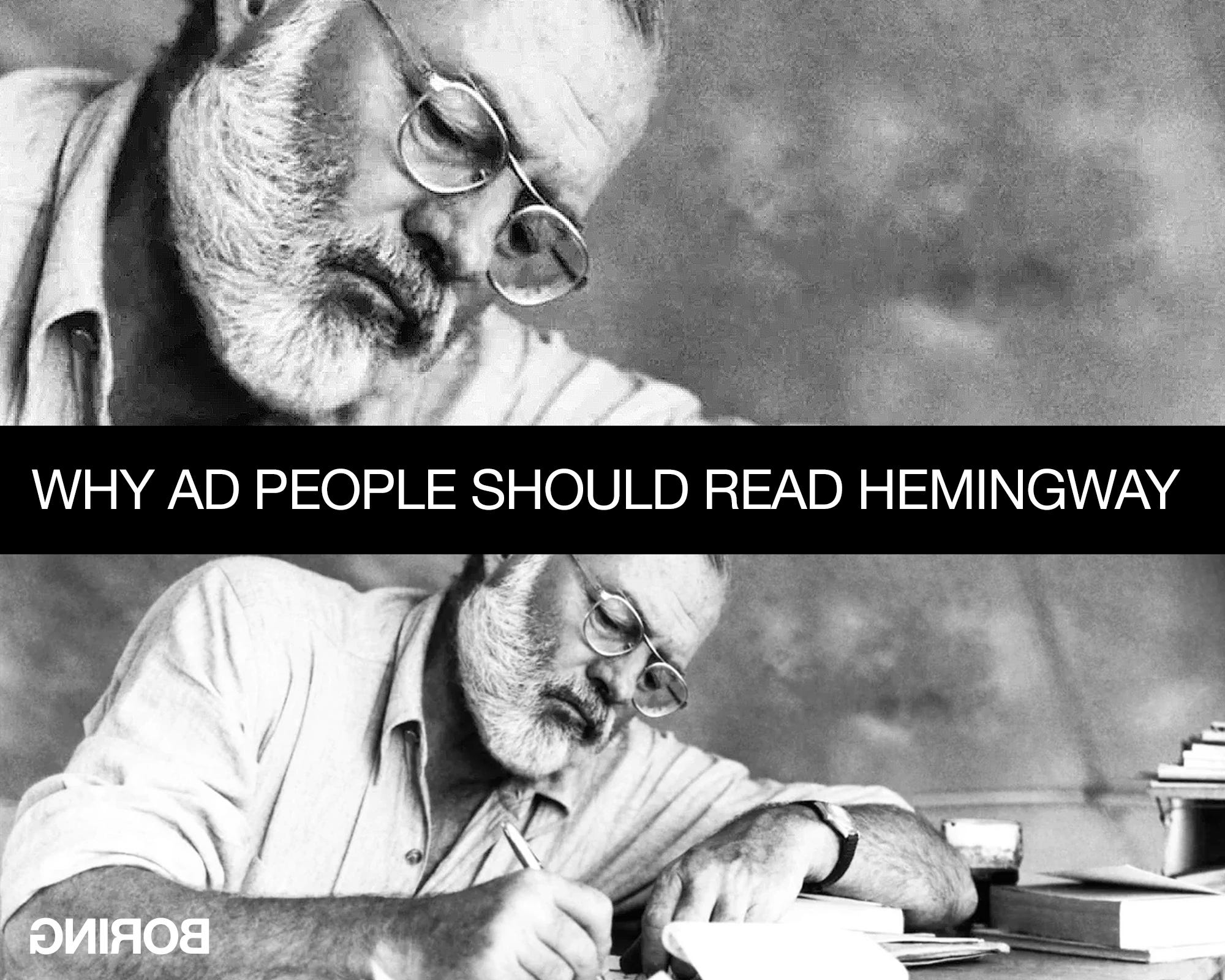
Every few years or so, people in advertising rediscover Hemingway, and realise just how much impact he had on modern copywriting. And you can really see why: Hemingway was extremely economical with his words. Rarely in history has so much been said with so few words.
And yet, if you pay attention, you'll realise that they often completely fail to "get it". Which is odd: Hemingway gave plenty of interviews discussing his approach. So, we know how he worked.
Many people in advertising paint Hemingway as a kind of literary Hitchcock, i.e. "leaving things up to the reader's imagination". And, just to be clear, there's nothing wrong with this approach: why show more when we can just imagine what happened?
But it's a fundamental misunderstanding of what Hemingway called his "Iceberg" theory.
Hemingway didn't leave things to the reader's imagination. He left things to the reader's 𝗰𝘂𝗹𝘁𝘂𝗿𝗮𝗹 𝗯𝗮𝗴𝗴𝗮𝗴𝗲. He practiced what we could call "cultural leverage": leveraging the concentrated power of cultural references to unpack a much greater image from a small amount of information.
For example, in "The Sun also Rises", Hemingway tells the story of Bill and Jake, two best friends on a bus trip through Basque country. They think—no, they are sure—that they are totally true to each other.
Still, one of them is going to betray the other. How do we know this?
Well, as they pass through the mountainous forests of Burguete, Bill complains about the cold. Jake tells him how high up they are, points to a village far away across the mountains, and says: "Look! There's Roncevaux."
That's it. One word: Roncevaux. It tells us everything we need to know.
Why?
Because Hemingway counted on every single one of his readers remembering Roncevaux from the medieval "Song of Roland", in which Roland is betrayed by Ganelon at the battle of Roncevaux, and Charlemagne exclaims: "Roncevaux! Roncevaux! O, traître Ganelon!"
The reason Hemingway was able to say everything in a single word is that he could count on the reader getting the reference. There is a fabric of knowledge that exists between humans of which Roncevaux is a part, so that Hemingway—known for his economy of words—was able to weave his story in the most economical fashion by just mentioning the name.
Now, why is it important to understand this correctly? Because advertising is an activity in which you need to say a lot with very little, and we've seen time and again that the most impactful way of doing that is by building a brand on the back of memory patterns the consumer already has in their mind, and then leveraging their significance in a new way to refresh them and renew the brand's top-of-mind status.
Just as a recent example, the reason the Pepsi polar bear advert worked was because Pepsi took for granted that the audience would get the reference that "polar bear = Coca-Cola" and "Taste Test = Pepsi".
In fact, that's precisely what Distinctive Brand Assets are: cultural references.