

What Veuve Clicquot Understands That Most Luxury Brands Don't
How to leverage your brand heritage to magnify your brand concept.

One of the things I most like to write about is ultra-tight brand concepts. The kind of brand concepts you could express in a single word. We’ve spoken about them in the context of Volvo’s “safety” vs. Alfa Romeo’s “love”, DHL’s “speed” vs. UPS’s “security”, Rolex’s “success” vs. Patek Philippe’s “legacy”.
Now, funnily enough, even though most of my clients are in luxury, the examples I tend to use come from non-luxury sectors. One of the main reasons is that it makes it easier to demonstrate how a brand concept is the primary shield against commodification.
But the pushback I most often get from marketers in luxury is that luxury is different.
They argue that a long heritage, an emphasis on craftsmanship, etc. somehow immunise a luxury brand against commodification, despite the fact that these are, basically, clichés i.e. intellectual commodities. Focusing on them will make your brand as noteworthy as a grain of rice in a bucket full of rice.
So, today, I’m going to give a very simple example of a luxury brand that, in my view, got it 100% right: Veuve Clicquot and their wonderful “solaire” brand concept.
The genius of solaire isn’t that it’s clever. It’s that, once you see it, it becomes so obvious that it feels like it was hiding in plain sight all along, waiting for you to catch up.
Veuve Clicquot has always been yellow. The yellow labels have been used since the 1870s to mark the bottles shipped to London, where the customers preferred a very brut style of champagne.
Madame Clicquot has always been associated with optimism, audacity and warmth. Her personal character was nothing short of radiant.
And, of course, champagne has always been a celebratory category.
But the mistake many luxury brands would make in this position is assuming that these things are enough—that leaning on heritage is strategy and all you need are distinctive assets to win the game.
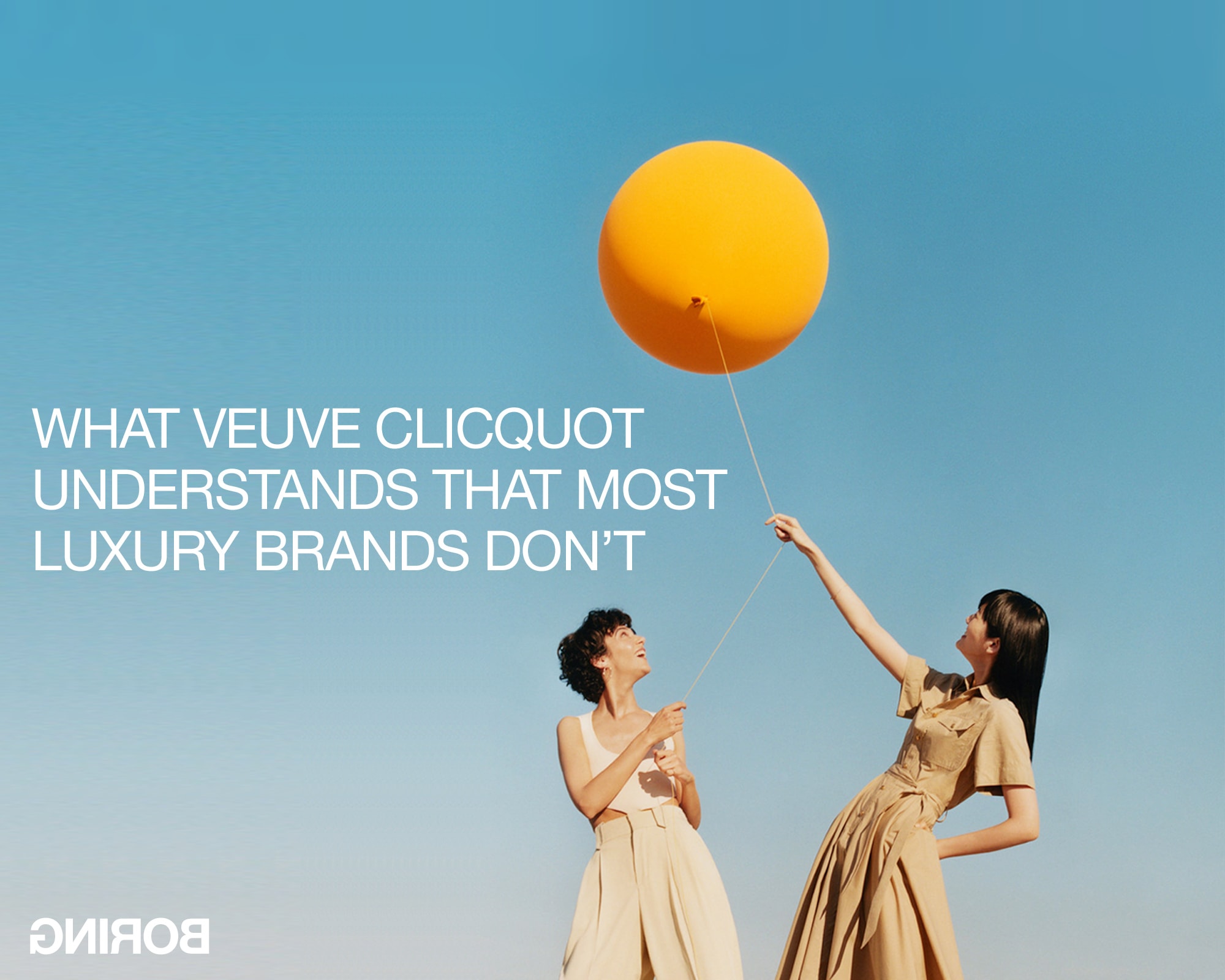
What Veuve Clicquot has done is decide that all of these things add up to something bigger and emotionally resonant: solaire. Not sunshine in the literal sense, of course, but sunlight as a feeling: warmth, optimism, generosity, summer, shared moments. The particular kind of joyful summertime feeling that can make a long lunch accidentally become dinner.
The funny thing is, once you’ve settled on a concept like that, decisions become a lot easier. Things just fall into place. You stop hesitating between campaign ideas and just ask “Are any of our ideas solaire?”
In other words, the brand concept becomes the ultimate Litmus test.
Take the Veuve Clicquot Sun Club. Lots of luxury brands do pop-ups. Lots of champagne brands sponsor terraces and rooftop bars. What Veuve Clicquot does differently is that it doesn’t simply put its logo on someone else’s idea of luxury. It creates an impressionist image of solaire itself. Sun-soaked terraces dressed in Clicquot yellow, inspired by the French Riviera, where people drink Veuve Clicquot’s RICH served extra chilled or over ice. Everything becomes an invitation into a very particular mood: champagne under the sun with nowhere urgent to be.
Even the product architecture supports the concept. RICH was designed specifically to be enjoyed very cold or on ice: a heresy for champagne purists, but a perfect expression of the solaire worldview. If your concept is sunlight, pleasure and conviviality, it’s incongruous to insist that people consume your product according to some arbitrary etiquette.
The concept travels remarkably well, too. The Sun Clubs appear in beach clubs, department stores, yachts and rooftop terraces across the world without feeling fragmented because they’re not united by a visual identity alone. They’re united by an idea. Wherever they appear, they are recognisably Veuve Clicquot because they are recognisably solaire.
The same goes for the brand collabs. Their “Chasing the Sun” collab with designer Yinka Ilori has a completely different aesthetic, but it’s another expression of the same idea. Somehow everything the brand touches becomes joy, colour, optimism and warmth translated into objects and experiences. The point isn’t that every expression has to look the same (quite frankly, that sounds exhausting...) It’s that they should feel like they’re expressing the same idea.
Solaire can become a terrace in Saint-Tropez, a picnic in Australia, a design exhibition in Milan or simply a bottle opened at four in the afternoon because somebody said, “Let’s stay for one more glass, I want to hear all about your holiday.” The concept survives because the feeling survives in a multitude of different expressions.
That’s the difference between having a collection of brand assets and having a brand concept. Veuve Clicquot’s greatest achievement isn’t that they’ve found a beautiful French word to describe themselves. Luxury marketing already has enough beautiful words. We’re all apparently passionate, authentic, timeless, disruptive and committed to excellence these days.
No, solaire is interesting because it materialises: Veuve Clicquot have allowed that one word to shape what they make, where they show up and how they make people feel.
I often think that one of the big fears luxury brand marketers have is that tightening their brand all the way down to a single concept somehow diminishes its complexity.
In reality, the opposite is true. The tighter the concept, the more expansive its possibilities become.
After all, the sun isn’t a particularly complicated idea, but it does a rather impressive amount of work at making Veuve Clicquot one of the most desirable brands in the world.