

What is the right EV strategy for Ferrari?
How do we innovate when the very legacy we have built is under threat by changes in the market?

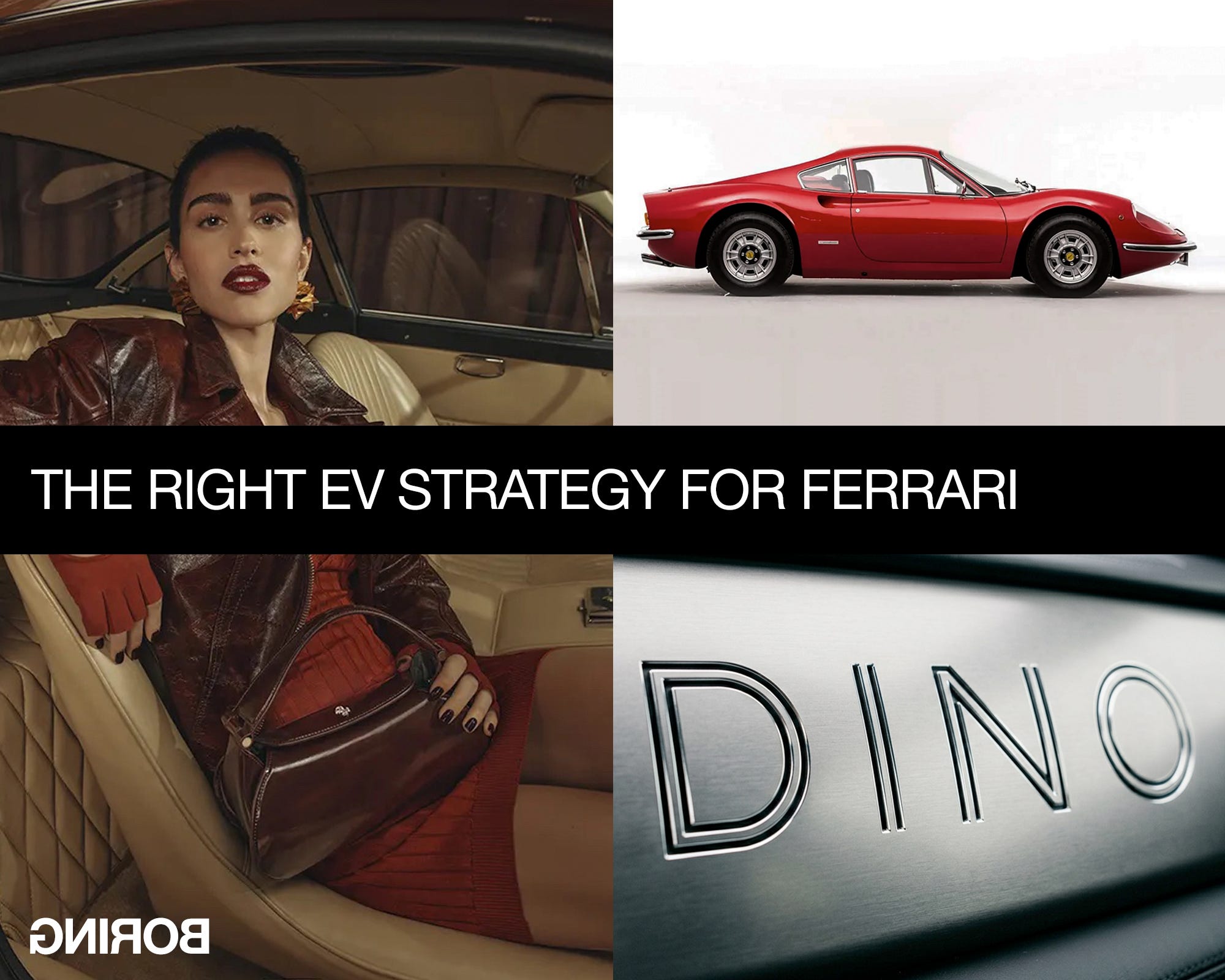
Since I wrote my first two Ferrari essays, a number of people have responded with something along the lines of “OK, but then how would you transition Ferrari to the world of EVs?”
So, that’s what this essay is going to be about: how do we innovate when the very legacy we have built is under threat by changes in the market?
Here it goes.
1. Deng Xiaoping
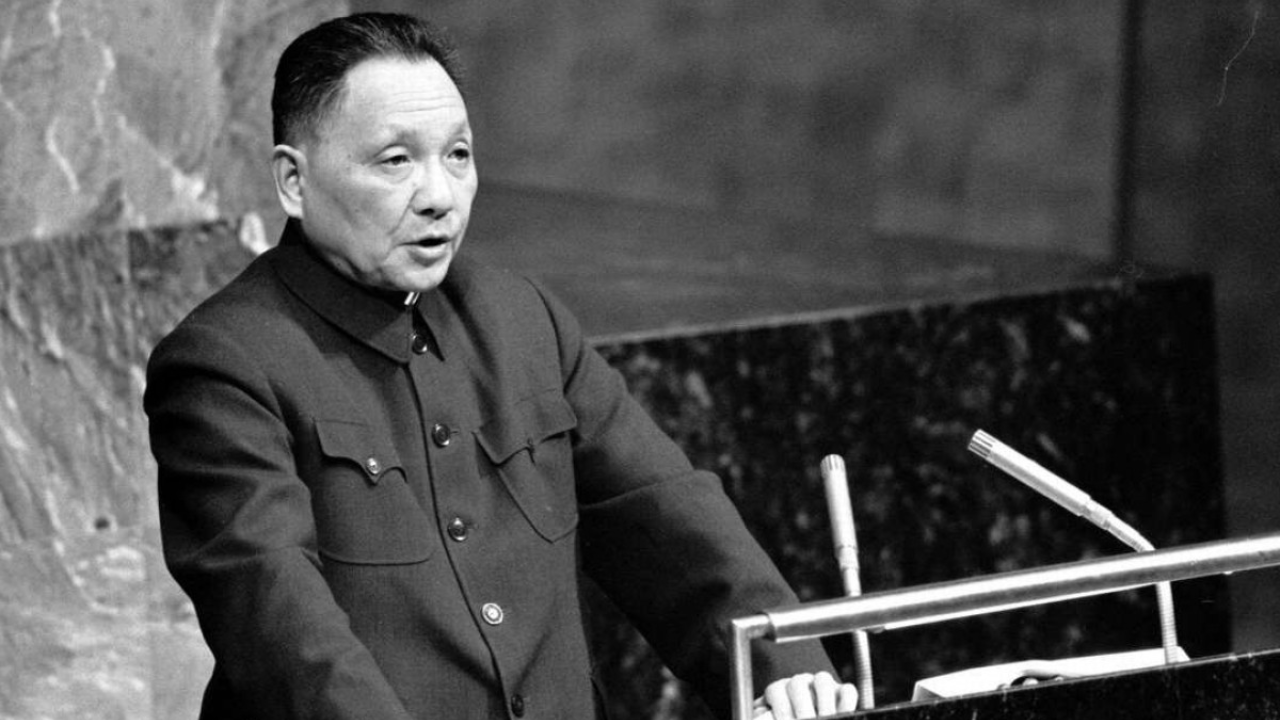
When Mao Zedong died in 1976, his successor Deng Xiaoping had a particularly difficult task: reverse China’s course of starvation and poverty that Communism was taking the country towards.
The big problem was: how do you do that without provoking another revolution? How do you orchestrate what is essentially a revolution, without triggering fire and guillotines?
Deng Xiaoping was open-minded enough to look outside of China for solutions. He famously said “who cares if the cat is black or white, as long as it catches mice?”
So, he visited countries whose cultural legacy wasn’t too different from pre-Communist China, to see what they were doing. Specifically, he travelled to Hong Kong and Singapore.
What he saw were city states that were thriving, using simple economic rules that enabled their citizens to create wealth. The kind of rules Nobel-awarded economists like Paul Romer, Daron Acemoglu and Joel Mokyr have been writing about for many years. Paul Romer calls them “charter cities”, new cities that are created with a specific charter. You don’t vote for the management or the policy, just like you don’t vote for who runs a restaurant or what’s on the menu: you just move there or you move somewhere else.
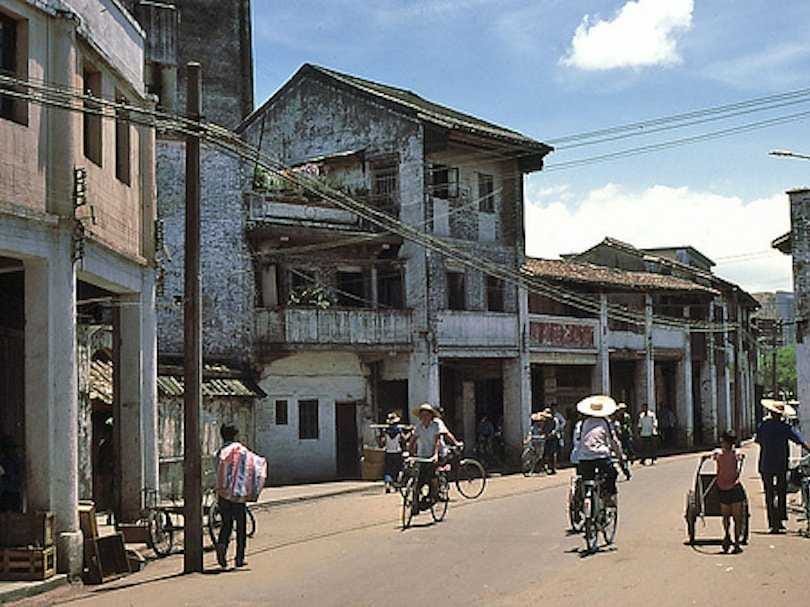
This is how Deng Xiaoping ended up creating new cities like Shenzhen, Xiamen and Shantou. He called them “Special Economic Zones”: cities that were part of China, but where the rules were very different from the rest of China. Shenzhen was a small fishing town before they turned it into a Special Economic Zone. Today, its population is over 20 million people.

Not only has Shenzhen grown into a successful city of over 20 million people, but it’s managed to re-direct China itself towards a future of prosperity: China now has a couple of hundred cities running similar development programmes, lifting hundreds of millions of people out of poverty.
This is how you harness disruption when you’re a large player who can’t afford what you already have to collapse:
Create a small, separate entity.
Cultivate it in another garden, so to speak.
Let its success direct the rest of your company once it reaches critical mass.
OK, now, the next question naturally becomes:
2. Are there brand strategy equivalents of this?
Certainly. In a way, this is precisely what sub brands are there for. It’s a strategic reason that’s been a bit forgotten for a while now, because too many brands have lost their ability to stay consistent for really long stretches of time. The sub brand gets used for a million purposes instead, many of them impertinent, some of them even destructive.
The very purpose of a sub brand is to allow a brand to navigate change in the market, experiment with future versions of it, and find new ways to “plug into” the consumer’s mind. Because, let’s not forget, the job of a brand is in the consumer’s mind. We are not at home, here, we are a guest in the consumer’s house.
Ferrari is a Branded House, not a House of Brands, and so it might be difficult to put themselves in this mindset. But what would a House of Brands approach be to changes in the market? Well, what did Coca-Cola do when their ingredients stopped being available in Germany during the war? They didn’t change Coca-Cola’s recipe; they launched Fanta. What did Pepsi do when a certain group of people turned out to like probiotic sodas? They didn’t change Pepsi to make it probiotic; they bought out Poppi.
That same way of thinking is what a Branded House in the lifestyle sector has to work with when disruptive change is in the air, only instead of buying out another company or creating a completely separate start-up, the right approach is to start a sub brand that has a very specific purpose of satisfying a consumer who is currently not being satisfied by the mother brand.
Let’s look at a concrete example in the lifestyle sector.
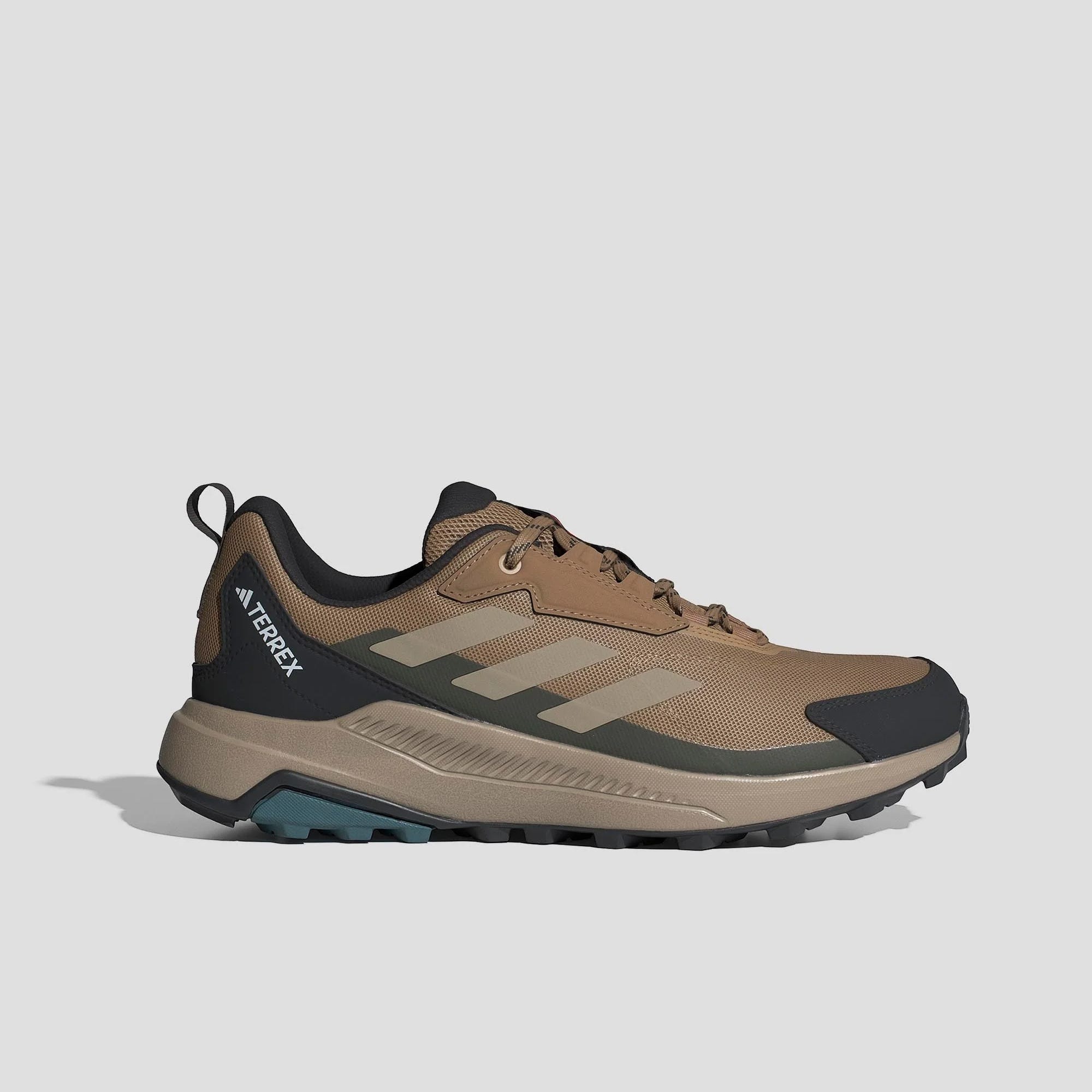
Adidas did it a few years ago with Terrex. We all know Terrex is an adidas sub brand. They even use the three stripes in their brand identity. But it’s both adidas and not-adidas, benefiting from the trust adidas has generated over the decades, but also benefiting from the different culture that can be grown from scratch with a completely different mindset that you’d get from a non-adidas that’s focused, not on urban wear, running tracks and so on, but rooted in the culture that has formed itself around the call of the wild, running in the woods, trekking, camping and forest bathing. “I went for a walk in the woods and come out taller than the trees”, as Henry David Thoreau would have put it.
It’s no wonder adidas understood it: the Germanic culture has a special word for this kind of outdoor activity: “spazieren”. I spent quite a while in Austria when I was a teenager, where “Geh spazieren” was the answer to every teenager problem you might have. But adidas understood that it was a different emotional and aesthetic register to the urban wear brand they’d spent many years building up. Hence, Terrex.
In our first essay on Ferrari, we discussed the strategic reason why Ferrari became a lifestyle brand (to avoid competing with its own products from the past, most of which are still available on the market today). And we discussed why EV was a “quartz movement” for the car industry, enabling any lifestyle brand to enter the car market: Gucci cars, Nike cars, Adidas cars, etc.
But, clearly this is something that takes a while even for Ferrari to get used to. You don’t stay successful at the lifestyle brand game just by extending into other product categories. You do it by understanding precisely what lifestyle brands do when change is in the air. Which, given the ephemeral nature of fashion and aesthetics in general, is something they’ve gotten used to. The idea of creating a sub brand is almost endemic in lifestyle branding.
3. What’s the problem we need to solve?
So, now, let’s look at a specific problem Ferrari has to overcome, by looking at a car brand that doesn’t have this problem: Rolls-Royce. Because, when I wrote in my previous essays that it’s not easy being Ferrari, we can assume there are other brands for whom it is easier.
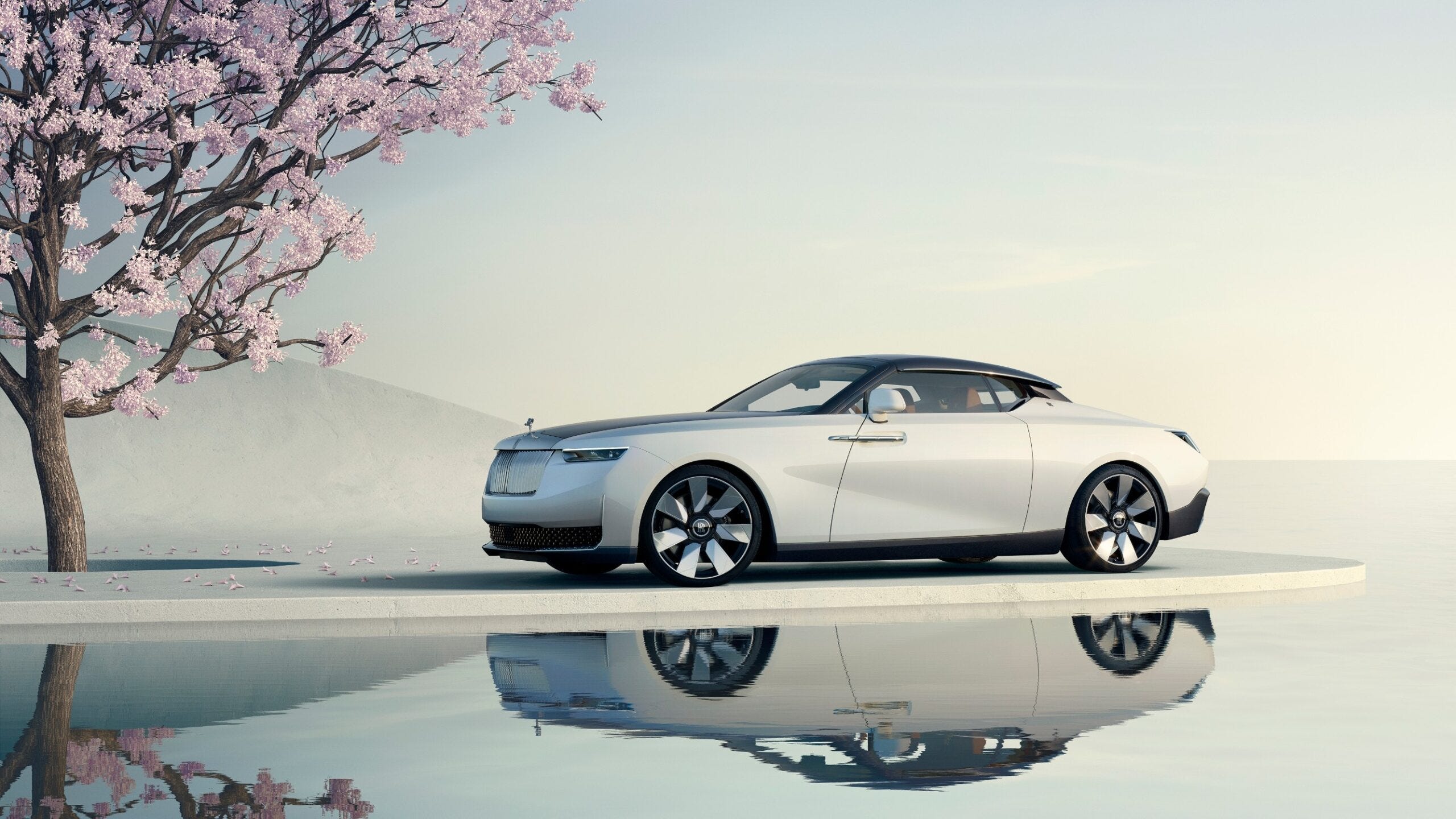
No luxury car brand has an easier transition to EV than Rolls-Royce right now.
Why?
Because the silence of electric motors is something they’ve been selling since the 1970s. The long-toothed readers among you will remember this advert, created by Ogilvy in the early 70s: “At 60 miles an hour the loudest noise in this new Rolls-Royce comes from the electric clock.”
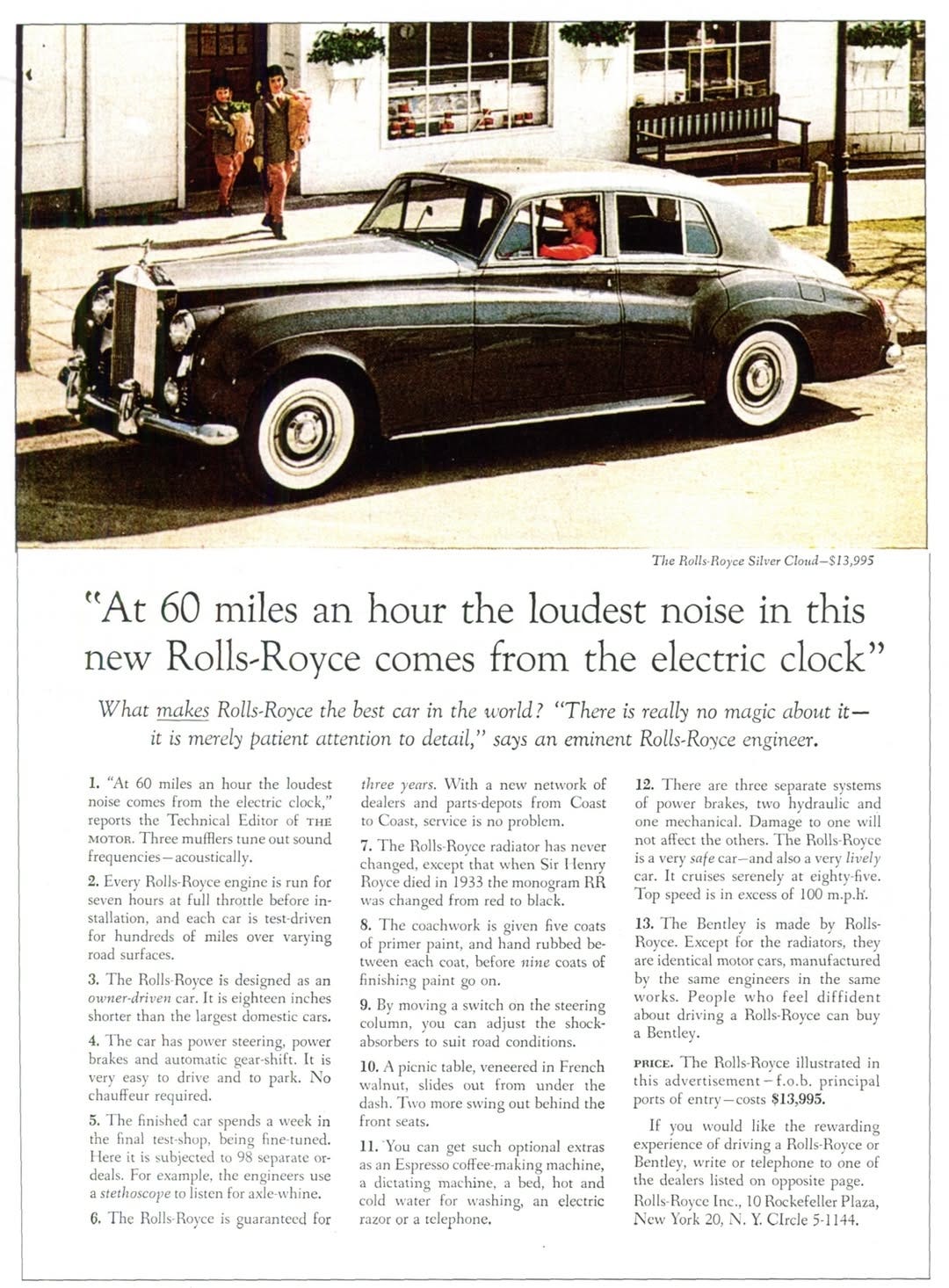
For Rolls-Royce, silence was always part of the appeal. What I really love about this advert is that it sells you silence by evoking a tiny sound that breaks it: the ticking of a clock. It expresses quality in the same way that Swiss watches express quality. In many ways, it evokes the same quiet as the “quiet luxury” everyone has been catching on to since Succession hit the screens. The quiet of Loro Piana, Bottega Veneta and Patek Philippe.
Funny how they already wrote “electric” to describe the clock. Rolls-Royce was made for the electric age and they didn’t even know it. They can just carry on carrying on, and stay Rolls-Royce all the way into the electric future.
Not so for our friends at Ferrari, whose products are the opposite of quiet. How many times have we heard Enzo Ferrari say things like “If it’s not a V12, it’s not a Ferrari”?
4. The solution
And, now that we mentioned Enzo’s line about V12s, here is—right for the taking—the solution that Ferrari came up with when people started taking an interest in different engines than Enzo’s V12: the DINO.
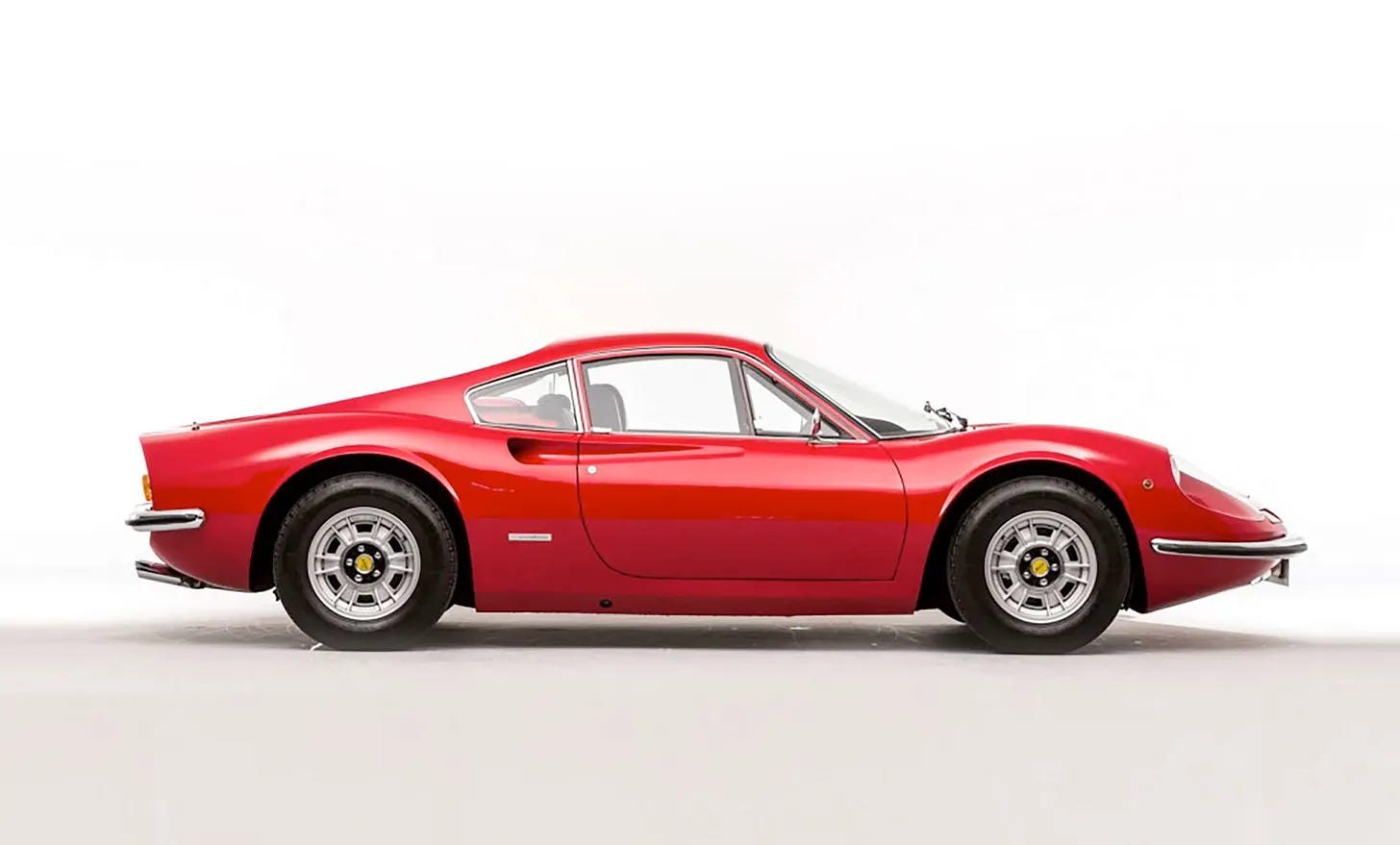
Isn’t it funny? In my first essay on Ferrari, I mentioned it as my favourite Ferrari from the past, and every Ferrarista in town understood what I meant. But they will also remember that the Dino was not a Ferrari.
At least, not for the first decade or so.
Dino was Dino, named after Enzo’s son, Alfredino Ferrari. It came with a V6 engine, which is the reason Enzo thought it inappropriate to put the cavallino on it (and you thought Luca di Montezemolo was the first one to utter those words?). Just like Terrex, the Dino was both a Ferrari and a non-Ferrari.
Both a Ferrari and a non-Ferrari... Which is exactly what the Luce is!
It’s both a Ferrari and not a Ferrari. And that’s great. It shows a view oriented towards the changing, evolving market. It shows experimentation. An open mind about what we could do. Great potential, in other words. But it’s also exactly the reason why Ferrari’s first iterations in EV cannot be Ferrari cars!
Ferrari needs Dino to be its Terrex.
Because, as we already discussed, the biggest threat to Ferrari is going to be the lifestyle brands entering the car market in the coming decade. Ferrari’s Luce doesn’t look much like a Ferrari, we can all agree on that. The thing you bought into just isn’t there in the Luce. So, now, imagine Gucci coming up with their own EV. Do you think Gucci’s EV will look “not very Gucci”? Or do you think, on the other hand, that it’ll look like the most Gucci thing ever?
The thing you’re buying into when you buy anything Gucci will be there in spades. Because Gucci clearly know something about lifestyle branding that Ferrari haven’t yet understood: when market forces lead towards commodification of technical excellence, the only thing you can still leverage is the distinctive brand assets that make consumers reach for you, because they make you desirable.
So, to summarise the 3-step strategy I would have adopted if I was in Ferrari’s shoes:
1. Announce a new sub brand—Dino... dedicated to an electric future. Evoke the heritage contained in the Dino mindset, a new engine for a new age. This is a sub brand that happens to benefit from all of Ferrari’s know-how, as well as being a sub brand the most dedicated Ferraristi will resonate with.
2. Open the new sub brand to collabs. It’s a creative brand, different and innovative. It’s the kind of brand that innovates in the open. No Soviet-style “here’s our new car, put up with it”. Create a new brand world around it that’s informed by the Dino heritage, but it’s experimental and new and just the right thing for Silicon Valley billionaires. Let the youth of Dino Ferrari contrast with the established Ferrari mother brand. Dino is allowed to be different from the mother brand. Go for it.
3. Ten years down the line, let the successes and failures of Dino inform the way forward for Ferrari in the electric world, much like the original Dino informed the way forward for Ferrari back in the 70s, when the brand was re-absorbed into the Ferrari ecosystem.
99% of newsletters are boring. Ours is gnirob. Subscribe.
Absolutely nailed it.