


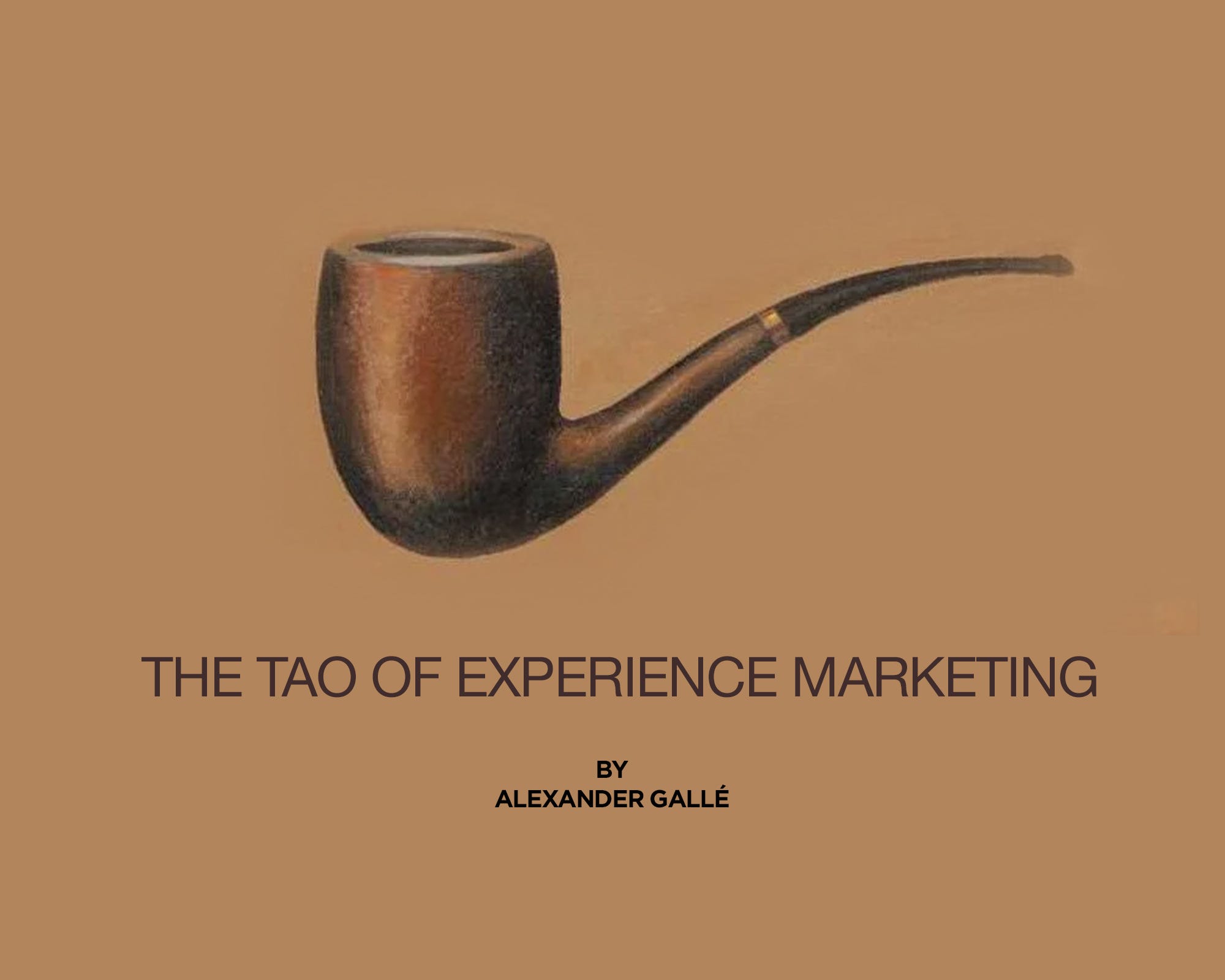
"The menu is not the meal."
— Alan Watts
In “The Cookies & Coffee Moment” we observed how Lotus—the Belgian speculoos cookie company—managed to differentiate itself by associating their speculoos, not to Christmas (in Belgium, speculoos were traditionally eaten around Saint Nicholas and the winter festivities), but to the coffee we drink every day.
Changing the cookie’s positioning in time was a fantastic way to increase the total addressable market from one that lasts one month to one that lasts all year: we’re looking at a 12x difference. We compared this creation of value to Edward Bernays’s repositioning of bacon as a “breakfast meat”, which allowed his client—the leading bacon producer in America—to grow its market free from competition.
An equally brilliant move we didn’t discuss very much is the fact that Lotus, in order to get there, did something very few companies would ever think of doing: they cut their traditional marketing spend almost to zero, and used the money to give away millions of cookies to cafés around the country, who put one on the saucer of every cup of coffee served to a customer.
The rationale was very simple: if we want people to associate our cookies with coffee, we’re not going to get very far by talking about them. Ultimately, they’re not going to “get it” until they experience the cookies and coffee moment for themselves.
Words cannot replace experiences. Try, for example, to describe in words what Beethoven’s 5th symphony opens like. Never mind describing the effect it has on you, just describe the melody itself in a way that I might recognise it when I hear it: what does it “do”?
Wittgenstein is one of the most interesting philosophers in this field. He spent many years exploring the logic construction of language in great depth, yet made sure to drive home the fact that language itself only manages to describe a tiny fraction of what the world “does”. He used a simple example to show its limitations: drop a towel on the floor, now try to describe in words alone the shape of the towel after it has landed.
I don’t mean this in a casual way: try to describe the towel in such a way that a painter who hadn’t seen the towel would be able to hear your words and paint something similar to the actual towel on the floor.
The limitations are so obvious, aren’t they? Once you see it through this lens, it becomes clear just how unbalanced most marketing people’s approach is, and how this brings about a reductionist understanding of your brand in the mind of the consumer. The brand becomes words, pictures, words about pictures, words about words, etc.
Of course, so many things in your life are now happening only in the online world. They may happen somewhere in the real world too, but you’re not perceiving them there, and your reaction to them is taking place in an equally mediated way. The mediated experience has taken up such a huge proportion of your time and thoughts, that you’d be forgiven for thinking it actually is reality.
Except, of course, that it isn’t.
And, for many consumer brands, it’s really important to remember that the real-life experience offers a potentially much bigger channel of expression than anything we can say in our adverts or PR campaigns, just like Beethoven’s 5th is much bigger than the words you might use to describe it, no matter how many books you write about it.
So, might there be a way for us to articulate a brand identity using channels that are not mediated? Well, yes, very much so. Just as words rely on context to convey meaning, experiences rely on experiential context to convey meaning.
For example, Heston Blumenthal’s Fat Duck restaurant strongly relies on the experiential context in order to elevate your experience of the dishes they serve. In an interview Heston gave a few years ago, he discussed how they designed their bouillabaisse-style fish soup to awaken a very pleasantly nostalgic longing in your mind, by designing its surrounding aesthetic elements to evoke happy memories of childhood holidays by the sea.
Or, going back to the example of Lotus’s speculoos cookies, the experiential context is coffee. No words are needed: all the positive emotional associations we make with coffee form the context in which the brand gets to articulate its meaning.
The way this works will vary from brand to brand. If you’re curious about finding new ways to express your own brand identity this way, it might be worth experimenting with the idea of pressing the “mute” button i.e. turning off the words altogether.
What would you do if there were no social media? What would you do in a world where advertising and PR were banned?
I’m a strong believer in guerrilla marketing, it always worked for my company—nothing compares with direct consumer delivery.
I love ❤️ the Biscoff example you cite here so well..because I witnessed its growth and evolution from Christmas cookie to coffee shop accoutrement. I thought it was a brilliant move!
When I had my men’s skincare brand (seems like eons ago 🤦♀️) we were launching a mens lip balm, tough sell due to drugstore blistex and other petrochemical-based balms…
Ours was natural, no PEGS, parabens, silicone no petroleum based Inci..etc..African Shea and Murumuru butter, Madagascar Vanilla-Bourbon
Moroccan mint and Rose and Neroli, locally sourced herbs and botanicals etc…
instead of advertising we spent the money on human resources—I hired gorgeous male models to hand out the balm at the Monterey Jazz festival and then Coachella in the sweltering heat. We sold out before we could even produce enough! We did the same for the launch of a natural ☀️ screen moisturizer— we distributed in ski resorts. Worked every time!
Great article Alexandre! 💫