


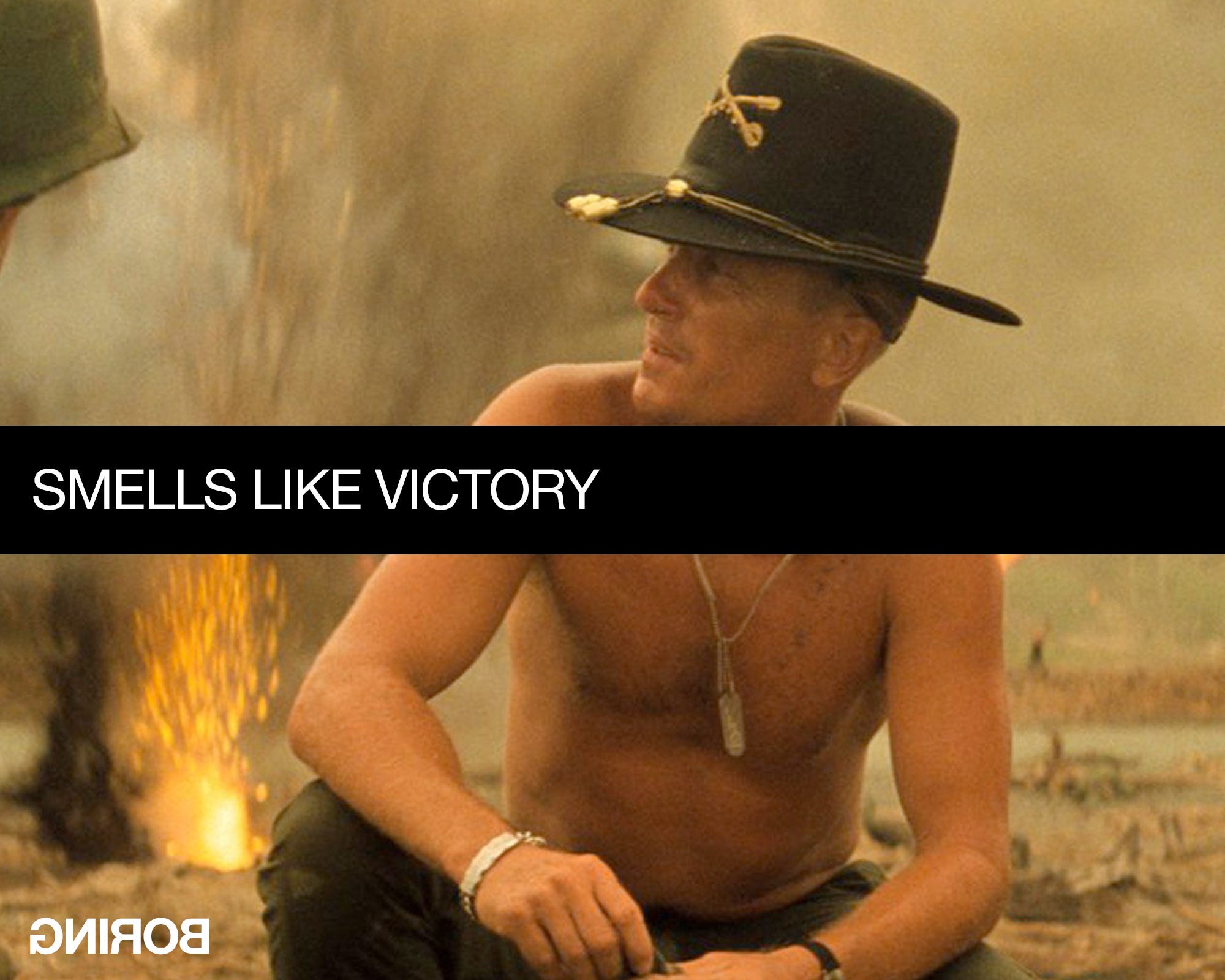
“I love the smell of napalm in the morning. It smells like… victory”, is one of the most memorable lines in Francis Ford Coppola’s “Apocalypse Now”.
In a number of essays, we’ve covered the idea that brands that stick to a simple brand concept will have more salience and memorability than brands that complicate their proposition with other factors (vision, mission, values, purpose, etc.)
I tend to use the words “brand concept” rather than, say, “brand story”. The main reason for this is that “story” leads brand managers down the road of thinking it’s all about words, when words are often just a small part of the concept. In “Apocalypse Now”, it’s the distinctive 𝘴𝘮𝘦𝘭𝘭 of napalm—not a story about napalm—that reminds Colonel Kilgore of victory.
Something else about the concept behind Colonel Kilgore’s love of napalm is how few words he needs to describe it. Just one word: victory.
This is what we’re going to talk about today: concepts so simple, you could say them in one word.
Here’s an example. Staples, the office supplies stores, make it really easy to find their bestselling items in the stores.
The price they pay for this is huge: if they made bestsellers hard to find, customers would put other things in their shopping cart on the way to finding what they were looking for. Customers would spend more!
So, why don’t Staples do this? Why do they forego the income from impulsive sales to lost customers?
Because their brand concept is “easy”. It’s the one thing that differentiates them from other office supplies stores. The way they see it, this sacrifice is the price they pay to be top-of-mind for everyone who wants to spend minimal time and effort on office supplies. Being top-of-mind is critical to them: they have to—yes or yes—be “the easy place to get what you need for your office” in order to carve the memory path in their customers’ minds that says “I need office supplies, let’s go to Staples”.
In effect, Staples are always sacrificing a bit of income today for extra income tomorrow, based on the compounding value of a simple and emotionally resonant brand concept. And I think this is what makes all the difference: when you pay an actual running cost for your brand concept, it forces you to stop treating it like the woo-woo many brand managers seem to be doing today, and actually do some proper work.
So, now, let’s see who else works with single word concepts? Many brands: Volvo (safety), Alfa Romeo (love), UPS (protection), DHL (speed), FedEx (overnight), Rolex (success), Patek Philippe (legacy), Corum (courage; at least, that’s what we created when we worked with them, but the company has been sold a couple of times since then), Yellow Tail (happy), , …
Twix, the chocolate snack brand, is interesting: their concept isn’t even tied very much to something specific about chocolate or snacks. The entire concept of Twix can be summarised in a single word: “two”. That’s it. There are two bars of Twix in every packet. Out of this simple concept, Mars have managed to build a billion-dollar brand, forever fuelled by fun things you can say and do when there are two of something.
For example, two chocolate bars implies that there’s a left and a right one, and that you might have to choose which one is your favourite. This naturally led to a campaign asking people to vote online for their favourite bar, Left Twix or Right Twix.
There’s a million ways you can make “two” fun: two Twix bars have a romantic story, two twins copying each other… You can even imagine what a brand collab could look like with this concept: it takes two to tango, so, do a fun brand collab between two Twix bars and a can of Tango.
Working with a single concept is hard. It initially feels like you’re leaving money on the table, because you could be appealing to these other people who want something else that your product could also satisfy. Once you overcome this mindset, though, the character of your brand will have a life of its own, and tell you what to do to succeed. All you’ll have to do is listen.