

It's not easy being Ferrari, Part II
What exactly is wrong with the Luce? And what can we do about it?

A few weeks ago, I wrote an essay on the change in strategy at Ferrari from a car brand to a lifestyle brand whose flagship products happen to be cars. That strategy is Ferrari’s natural response to their biggest competitor, “Ferrarieri” i.e. yesterday’s Ferraris: all the past Ferraris that are still on the market, which Ferrari’s target audience could buy instead of buying a new Ferrari.
In the process, I outlined a change that EV technology has made possible: the entry of lifestyle brands into the car market. Just like quartz movements enabled the entry of lifestyle brands into the watch market 50 years ago. Specifically, brands famous for leather bags, shoes, sportswear, jewellery, etc. partnering with tech manufacturing companies like Xiaomi to introduce, say, Gucci, Armani, Nike or Chanel automobiles to the market.
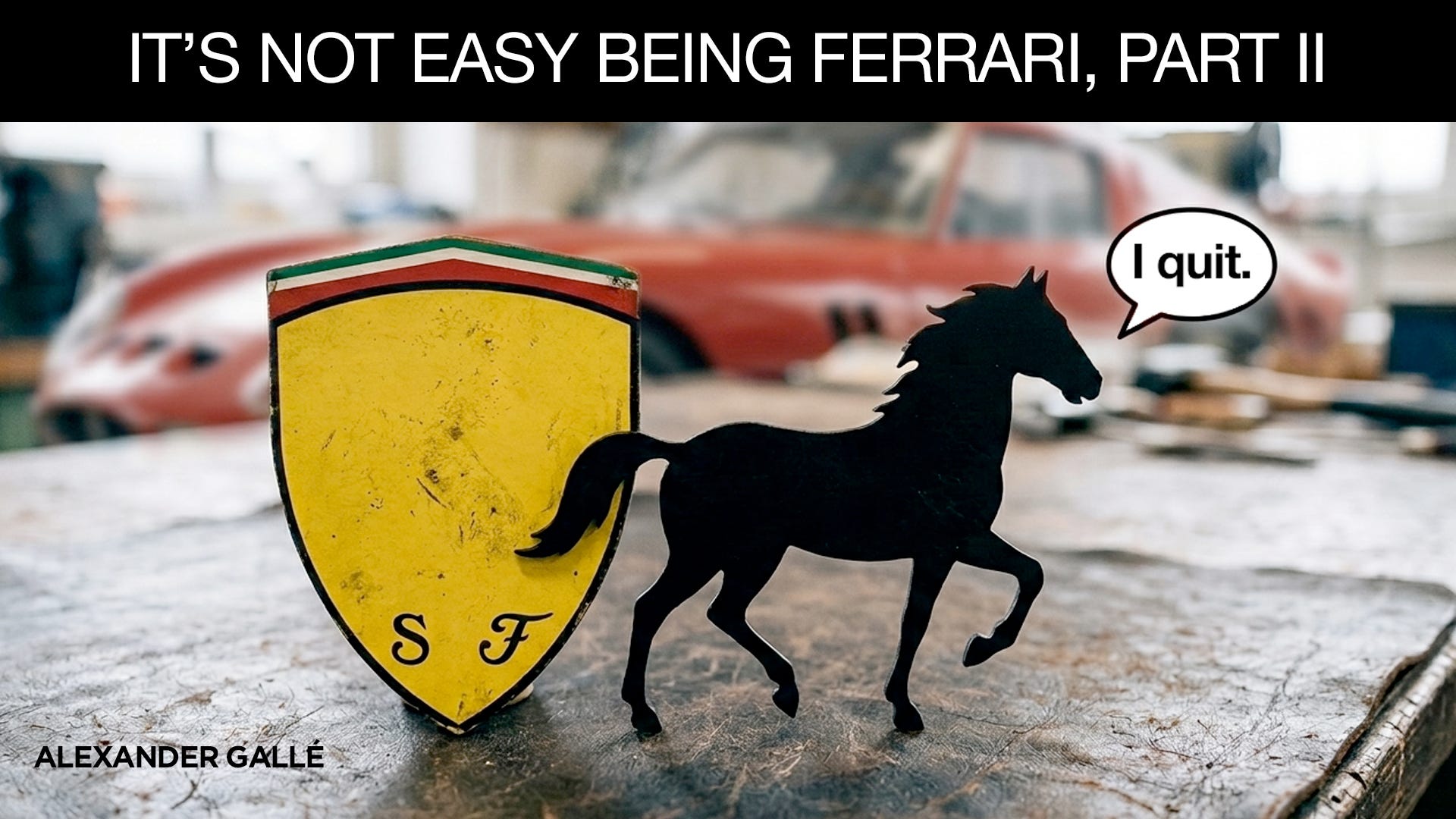
Ferrari have, in the meantime, premiered the Luce and, as expected, the backlash has been epic. The share price dropped 7.5% the next morning. Thousands of fans got angry or burst into tears. Even the horse on Ferrari’s own logo threatened to quit.
OK, I made up that last one (thank you, Google Gemini). But what did happen is that Luca Cordero di Montezemolo, Ferrari’s former Chairman, said “I hope they remove the cavallino from that car”.
It’s an interesting time to be in this business, for sure. Although the noise can be a bit overwhelming... So, let’s take a deep breath, focus on the issue at hand and get to work.
1. Brands and cultures
First, let’s create some order around what a car—or any product—actually is: a by-product of a culture. To use the correct 2026 nomenklatura: the product is a manifestation of the brand.
The product is, as it were, downstream from the culture, which is itself downstream from the brand concept. Why are cars from, say, Volvo different from cars from Ferrari? Because the people working at Volvo are not the kind of people who would work at Ferrari. They’re interested in different aspects of design, and that’s the reason why they’re working at Volvo and not at Ferrari.
What are they interested in? Volvo’s brand concept: safety. It’s a brand concept Volvo have been hanging their coat on for the past fifty years or so.
So, before we address the issue with Ferrari’s Luce directly, let’s explore the idea of brand concepts and cultures by playing around with another brand—Volvo—whose concept we understand. Let’s have some fun with it.
Imagine if Volvo decided to “jazz things up a bit” and started a new project to show that Swedish cars can be as sexy as Italian cars.
You can easily imagine getting somewhere with that, can’t you? After all, there is an idea that people have of “Swedish sexy” out there in the world. And it’s definitely a different vibe, a different aesthetic to “Italian passion”.
So, now, let’s imagine that in the few years it takes for Volvo to get this new sexy car design on the road, PR agencies get hired to build up the narrative. Travel and lifestyle magazines start talking about “the Swedish Hamptons” look. Someone directs a remake of “Elvira Madigan” starring Margot Robbie. People outside of Sweden finally discover Stockholm’s fashion district. Did you know they even have their own fashion week? Sweden is sexy!

After a couple of years, they launch this car and it sells! Everyone at Volvo does a round of high fives. Design school graduates who used to apply for jobs at Ferrari now apply for jobs at Volvo, which naturally brings about a change of culture at the company.
But then, imagine that a few years later, sales start dropping. Some other consultants are brought in. They tell Volvo that the younger generation just don’t buy into all this sexiness. In fact, they say, it turns out that the latest generation don’t like this whole sexy (“sexist”) narrative at all.
So, in yet another twist, Volvo then decide to capitalise on some of their Swedishness. Another “brilliant idea”: let’s do a design partnership with IKEA and build a Volvo campervan! Of course! Why didn’t we think about this before? Let’s throw in some of that scandi interior design style, with some extra hygge on top. And make it affordable, so the IKEA-going young families don’t feel they’re priced out of this market.
Can you see how, with all these twists and turns, people might start wondering what it is they’re supposed to buy into when they buy a Volvo? There may be a market for all these ideas, but it’s clear that if you did these acrobatics for a few years, you’d soon end up with Volvos that stopped looking like, well, Volvos. They would operate on a different emotional register.
2. What is the Luce’s problem?
So, now that we’ve illustrated the importance of brand concepts with this folly, let’s go back to our dear friends at Ferrari and the problem of the Luce.
The problem is not that the Luce is electric. You don’t need the sound of roaring lions for a car to evoke passion and sexiness.
The problem is not that Jony Ive is an outsider to the company. Ferrari have worked with outsiders for the past 70 years, most notably with Pininfarina.
The problem is not even that Jony Ive is not a car designer. Plenty of great cars have been designed by people who weren’t car designers. Citroën’s DS, Ami and 2CV were designed by a sculptor. Jaguar’s E-Type was designed by an aerodynamicist.
The problem is that Jony Ive and the team at LoveFrom operate with a different emotional register. They idolise designers like Dieter Rams and his minimalist designs for Braun. They idolise Bauhaus and functional architects who like their designs to be calm and collected. Their idea of good design is design you don’t even notice, because it’s a frictionless and unobtrusive “user experience”.
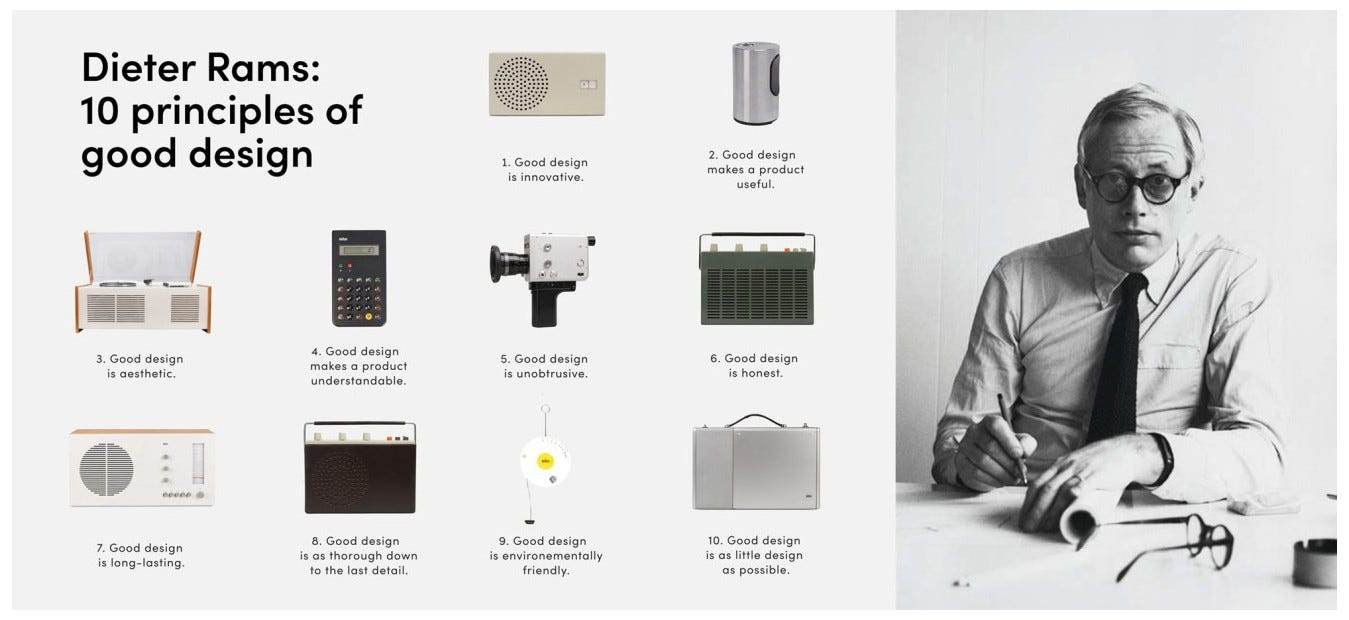
And, just to be clear, this is a perfectly valid design outlook.
But it’s still a problem, because Ferrari doesn’t do frictionless and unobtrusive user experiences. Ferrari doesn’t do calm and collected. Ferrari doesn’t idolise Bauhaus and Dieter Rams. Ferrari idolises design that takes your breath away, that makes your heart beat faster, not slower. Ferrari, to keep things simple, does passion.
In other words, Ferrari is a different culture. It’s a different culture, originating from a different brand concept. You’re off-brand, Jony!
“But I’ve said the word ‘passion’ at least 10 times since we launched the car!” replies Jony.
It doesn’t matter how many times you say it. Nobody believes it until they see it. So, show it, don’t say it. It’s a rule they teach you at film school.
3. If Ferrari was a film
Funnily enough, speaking of film school, films is a really good way of thinking about it. What film do you imagine this car to be in? Does the world in this film look like Ferrari world? Even if you’re thinking about a design “from the future”, does that future really look like as sci-fi dystopia à la Tron meets Bladerunner 2049?
Speaking of sci-fi dystopias, one of the first campaigns I worked on, thirty years ago, was for Starship Troopers. There’s a scene in that film, where all the soldiers—men and women—are in the showers. And, given that they’re all healthy and fit, you might think they’re going to get a bit sexy. It’s a Paul Verhoeven film, after all.
But they don’t. They don’t get sexy at all. They just talk about why they enlisted in the army. A large shower room full of fit and healthy young people, and all they talk about is their careers and ambitions (“I’m doing my part!”)
Why do I mention this? Because the Luce’s specific way of being off-brand is that it’s basically not sexy. It’s so not sexy, the designers don’t even know it’s not sexy. Jony Ive and the LoveFromers have spent decades designing products for a generation of puritans: young men and women who’ve been told they have to go to the gym to be healthy and fit, but they’re not allowed to enjoy the by-product of being healthy and fit, i.e., feeling sexy.
In other words, the problem is that the Luce has been designed, not by Ferrari-outsiders, but by Ferrari-aliens. Designers who are alien to passion. The Luce is a passionless designer’s idea of what a Ferrari looks like, just like a porn film is a virgin’s idea of what making love looks like.
So, now that we’ve found the problem, what do we do about it? Is this the death of Ferrari?
On the contrary, it’s an opportunity.
First of all, the clever thing about hiring an outsider on an audacious project is that you can always blame them if things go wrong. It’s not our guys, it’s them guys. They just don’t “get us”. Firing them will be easy and the Ferrari brand will remain intact. That’s not to say we can’t work with them, but there are other ways of doing that, and I’ll get to them in Part 3 (yes, there’s a part 3!)
Second, seeing the opposite of what we are is often a really good way to discover what we actually are. If they open their eyes and ears to their fans’ laments, Ferrari will have an exact understanding of where it is they need to go with their future cars, electric or not.
In other words, the lessons learned from messing up the Luce are the best way to ensure Ferrari will know the type of car they should design for at least a generation: just design the anti-Luce and they’ll be just fine.
Is your email inbox boring? Make it gnirob with this one easy trick.
😂 “Because the Luce’s specific way of being off-brand is that it’s basically not sexy. It’s so not sexy, the designers don’t even know it’s not sexy.” 🤣 My thoughts exactly when I first saw the LUCE. And what’s in a NAME? Does Luce have a meaning? Never was a fan of Bauhaus..
Almost fell off my chair when I read your Elvira Madigan comment 😂 good casting call Margot Robbie.. Also I have never thought of Sweden as Sexy, visited once, their fashion sense and culinary taste both atrocious.. sorry. Perhaps their sauna & nudist culture?
But you’re right on point when you say Ferrari can learn from this and just blame the outsider!