


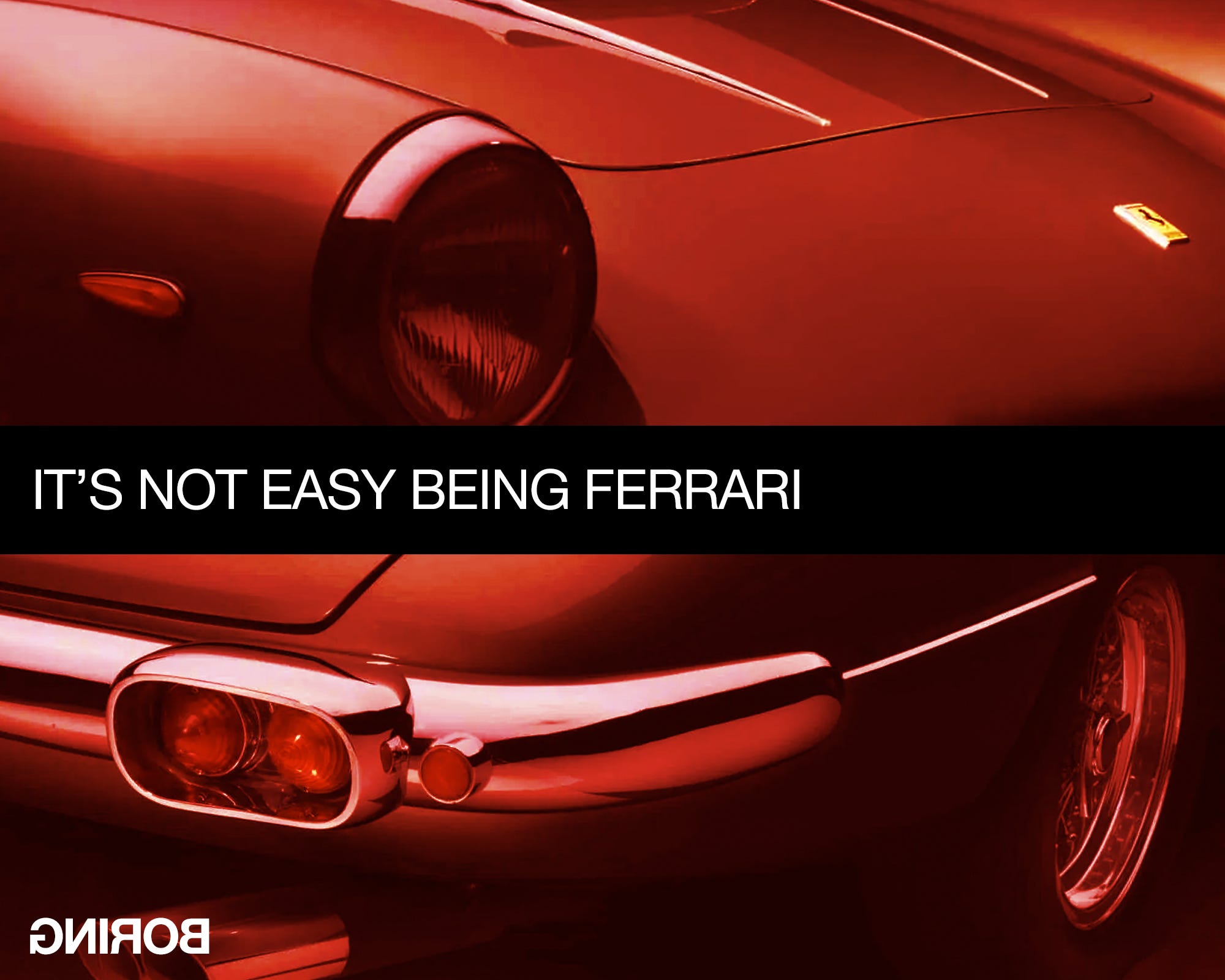
A few years ago, Frank Stephenson and I were discussing a car that had just been launched, when Frank joked that it looked like two designers who hated each other had agreed that one of them would design the front and the other design the back.
Aside from being spot on, it was a clear example to me of what happens when a car company loses its brand concept: instead of trusting their designers to re-interpret the over-arching brand’s design codes, the company ended up depending on the designers’ own, personal, design values to decide the aesthetic.
It was a bit of an epiphany moment because, for the first time, it was a clear sign that brand concepts matter, and not only in the narrow sense people usually think of when they talk about branding and marketing (advertising, promotion, etc.), but in the very product itself as a manifestation of the brand concept.
So, now, let’s ask ourselves a simple question:
1. What should a Ferrari look like?
It’s a question many people are going to be discussing soon, since Ferrari are about to reveal what the Luce—their first EV—looks like from the outside.
Funnily enough, it’s a question that brings us back to Frank, since he was Ferrari’s first ever design director. There were two things he was in charge of when he was in that role:
1. Designing the F430, FXX Enzo and the other models of his era.
2. Defining the design codes that made a Ferrari look like a Ferrari. The visual elements that would connect future Ferrari models to past Ferrari models. You could call it Ferrari’s “design DNA”, or style guide.
Now, here’s Frank’s latest “HOT or NOT” article for Top Gear, reviewing the new Ferrari 849 Testarossa.
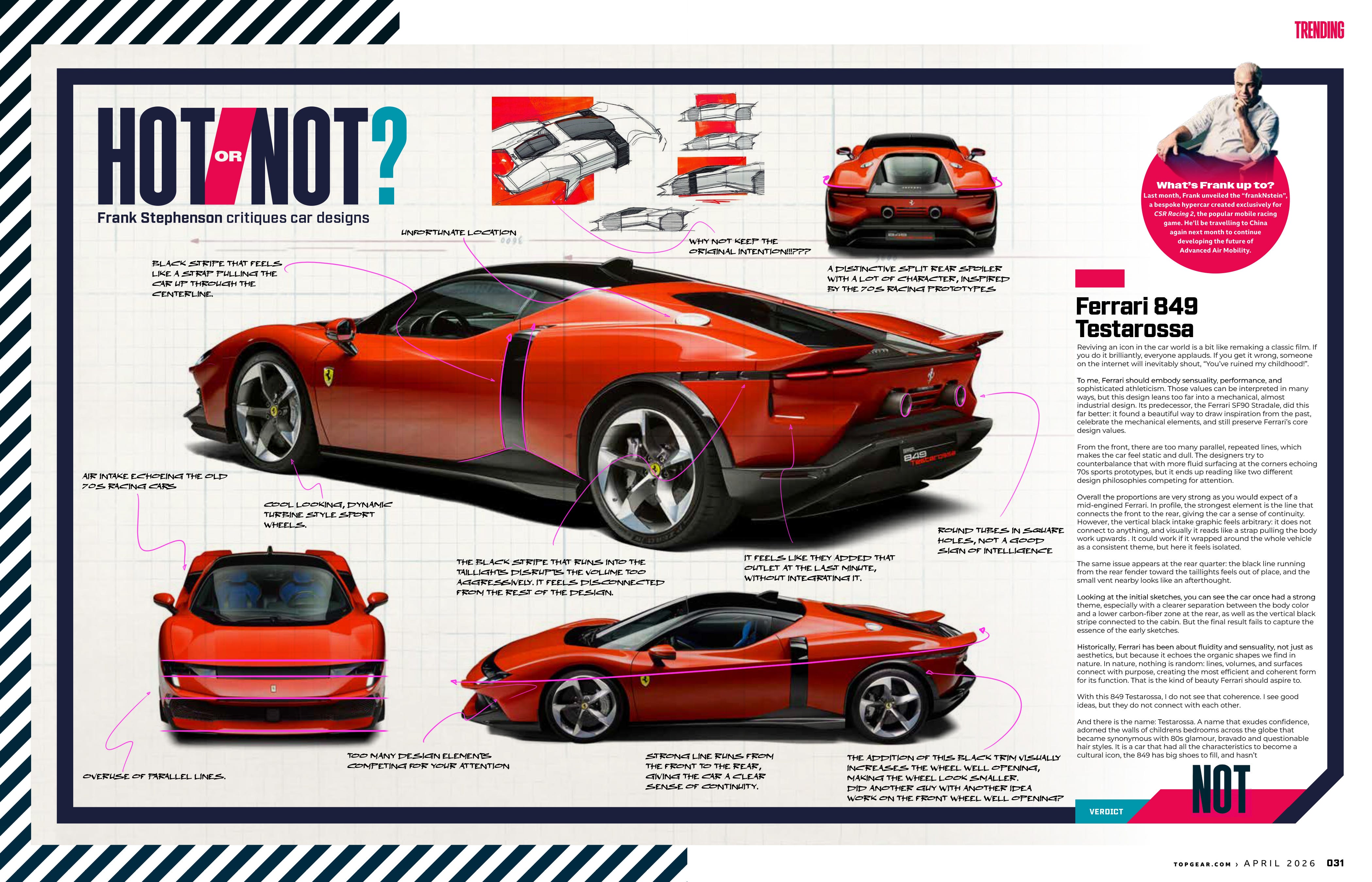
The level of detail and reasoning is pretty much what you’d expect from a great designer who actually wrote Ferrari’s style guide. And the fact that this car is a “NOT” makes you wonder what happened to that style guide in the last 20 years or so.
2. Style guide vs brand concept
The annoying thing about style guides, is that they often feel like the brand is going to be OK when the creative director leaves the company (“hey, just follow these instructions”) but they quickly stop being used when a new team takes the reins. And if they’re not used, it’s mostly because they tell you what things should look like without telling you why they look the way they do.
To illustrate the point, think about someone in your life whose style you really like. If you pay attention, you’ll quickly notice that their style isn’t so much a fixed set of items they always wear. It’s not even a general colour palette. It’s more that they have a point of view. Their point of view dictates their aesthetic. If you wanted to emulate them, copying their aesthetic would only get you so far. What you’d really need to copy is not how they look, but how they see.
However, a brand is more than a person. A real, lasting brand signature is not an aesthetic, but it’s not one person’s point of view either, no matter how iconic they are. A real, lasting brand signature is its concept.
The brand concept brings about a culture—distributed over many people, not just one person—which is as close as a company is going to get to a point of view. The aesthetic is a by-product of this culture, and the culture is downstream from the concept.
One classic way to illustrate this might be to look at a car that many Ferrari drivers might buy as their family car—Volvo. We all know exactly what Volvo’s brand concept is: safety.
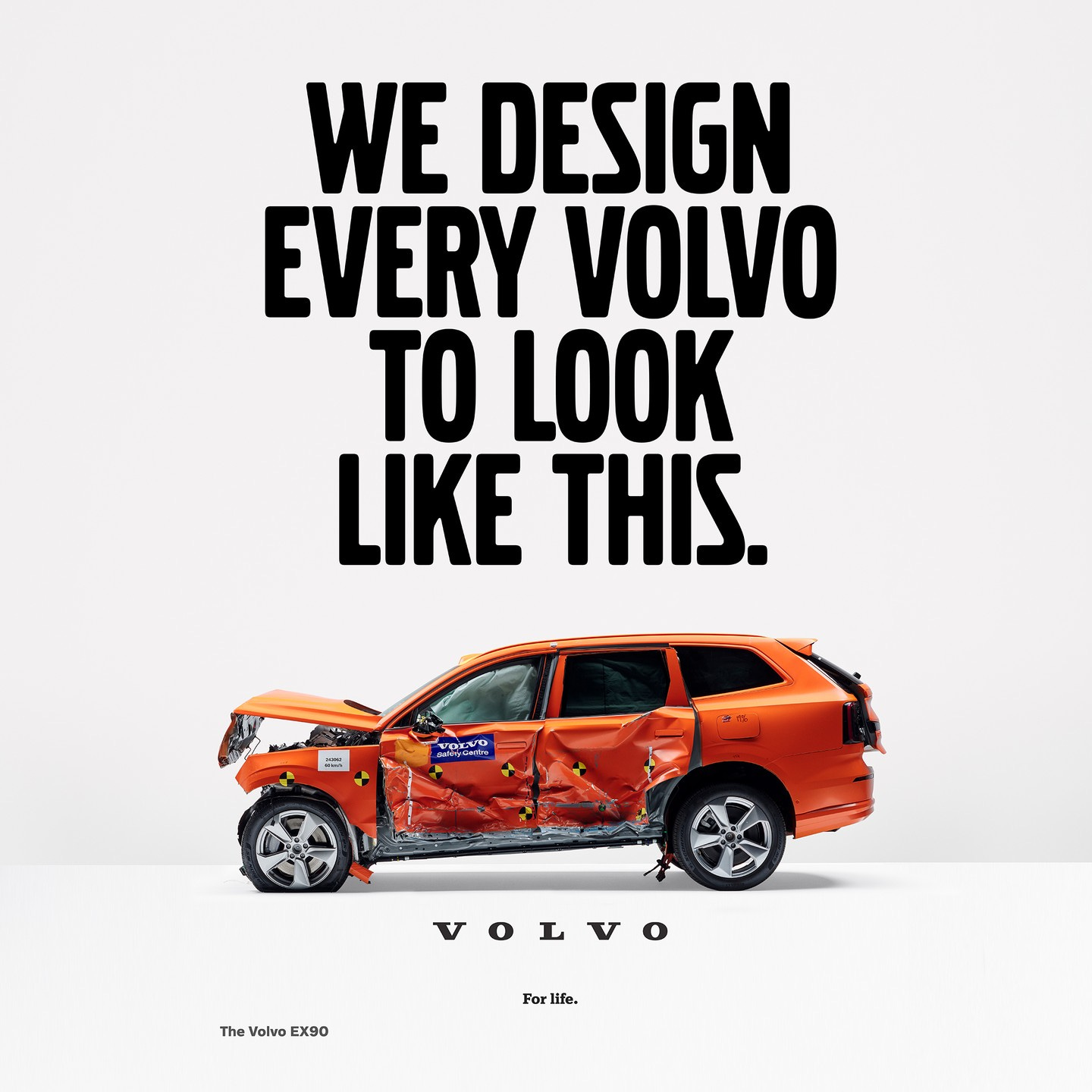
And they don’t just talk about it in their ads. The designer who might apply for a job at Volvo is a very different person to the designer who might apply for a job at Ferrari. The things they talk about in their meetings, the music they listen to when they’re driving, the pictures on their moodboards, all end up manifesting differently in the sound of the doors, the colour palette on the dashboard, the smell of the seats, the haptic feedback on the accelerator, the shape of the buttons, the texture of the gearstick handle, etc. Everything is different. The aesthetic of the cars is a by-product of this culture, and the culture is downstream from the brand concept.
So, let’s look at the question again: what should a Ferrari look like?
The answer is clearly another question: what is Ferrari’s brand concept?
However, let’s not rejoice at this answer too soon! Framing Ferrari in the context of other car brands might have made sense 10 or 20 years ago, but the world has changed, and there’s something we need to address that many people who used to hang pictures of Ferrari’s cars on their walls when they were 13 will find hard to swallow:
3. Ferrari has long ago stopped being a car brand.
It would be far more accurate to say that, for many people, Ferrari is now a lifestyle brand whose flagship products are cars. Just like, say, Hermès is a lifestyle brand whose flagship products are Birkin bags, but whose revenues mostly come from prêt-à-porter, accessories, scarves and fragrances.
If you go to the Ferrari website today, you’ll land on a page selling handbags, jackets, shoes, sunglasses and accessories.
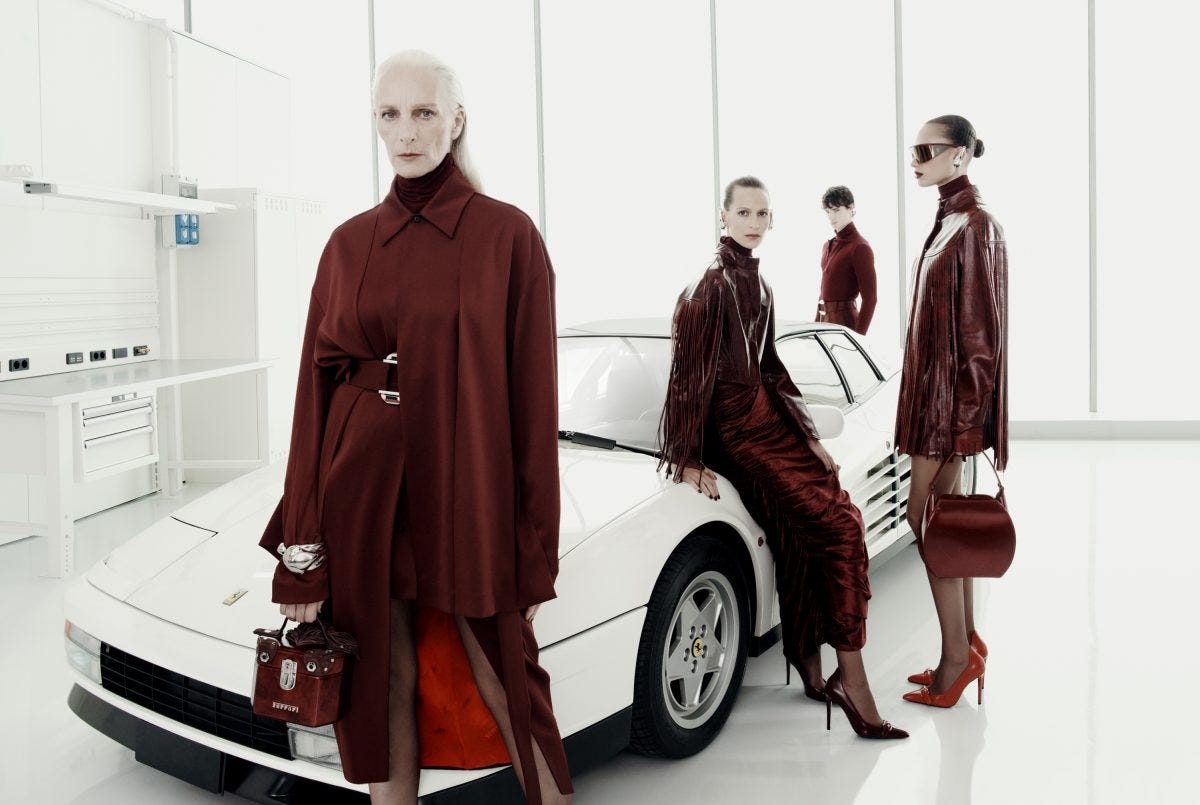
Ferrari has extended out of its product category, the same way Nike extended out of the running shoe category, the same way Gucci extended out of the leather shoes and handbags category.
This is a pretty big deal for Ferrari. It’s definitely the kind of thing that reshapes the brand’s destiny. So, the first thing we need to ask ourselves is: why?
4. Why did Ferrari jump out of its product category?
The answer is quite straightforward. Ferrari’s big competitor is not other supercar brands. Ferrari’s big competitor is… the ever-growing second-hand Ferrari market.
Think about it: Ferrari’s cars aren’t the kind of cars that end up in a landfill, to be replaced by newer models. Nearly every Ferrari ever made is still in circulation. Which means that every new car produced by Ferrari has to compete not only with other car brands, but with all the cars Ferrari itself has produced since 1947!
If we give this market a name, we’ll be more aware of it as a direct competitor. So, let’s call it ”Ferrarieri” (as in, “tutte le Ferrari di ieri”, all of yesterday’s Ferraris). Here is one of Ferrarieri’s most beautiful models: the Dino.
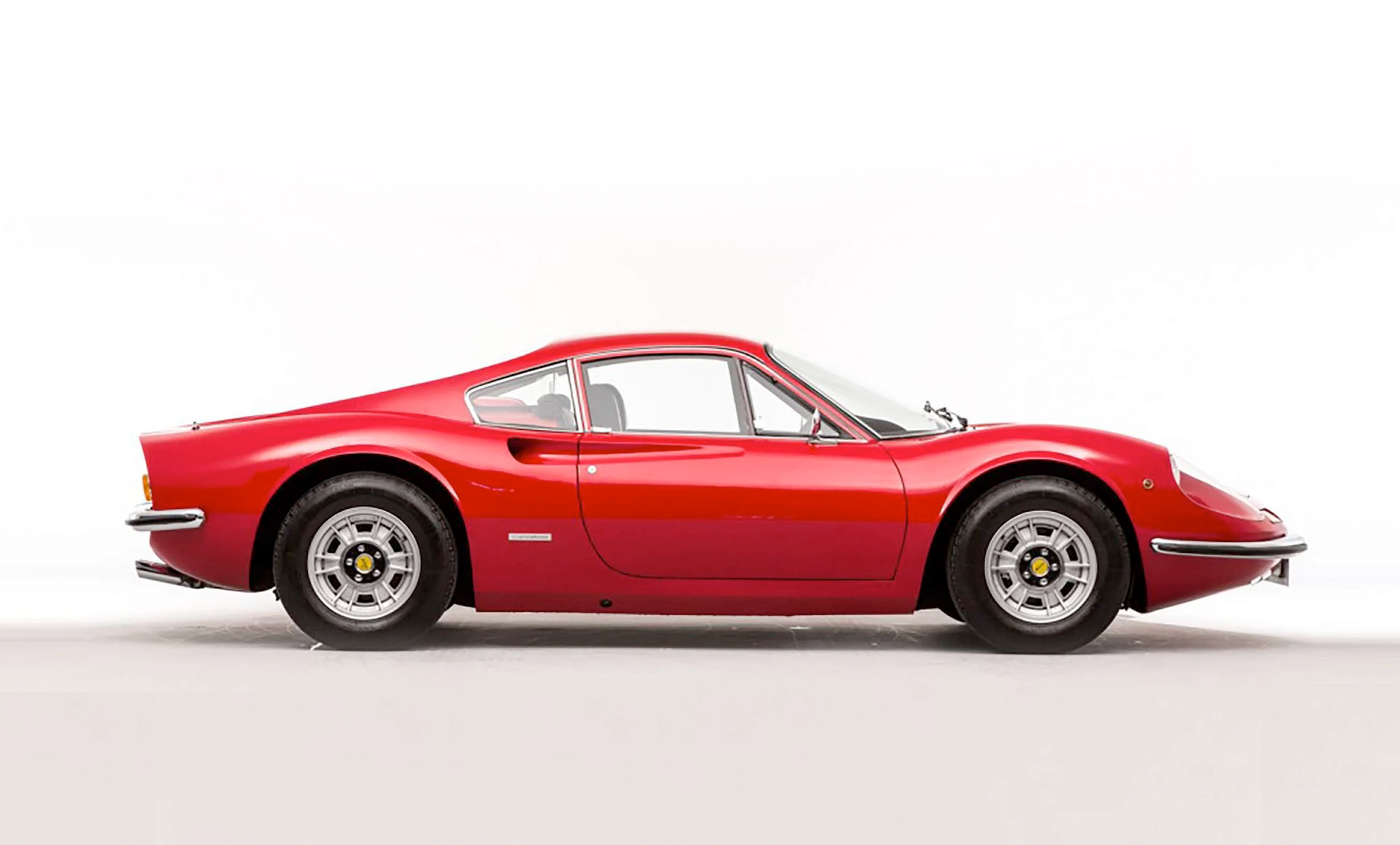
It was named after Enzo’s son. Its price tag today puts it in direct competition with many new Ferrari models. And it’s by far the most desirable classic car, ever.
Now, Ferrari is a company whose business model has always been based on the development of scarcity. To quote Enzo Ferrari himself: "Ferrari will always deliver one car less than the market demands."
But you don’t get to do that with 350,000 Ferrarieri cars in circulation, any one of which could become available to a buyer with sufficient funds.
So, this is clearly a problem. Ferrari’s target audience, i.e. customers who want and who can afford a Ferrari, can either:
- buy a new Ferrari.
or
- buy a Ferrarieri built between 1947 and yesterday.
Is there a way to stop Ferrarieri stealing Ferrari’s customers away? No, and neither would we want that to happen, of course, since Ferrari depends on this legacy to sustain its perception of value.
So, then, is there a way Ferrari can benefit from the existence of its competitor, Ferrarieri?
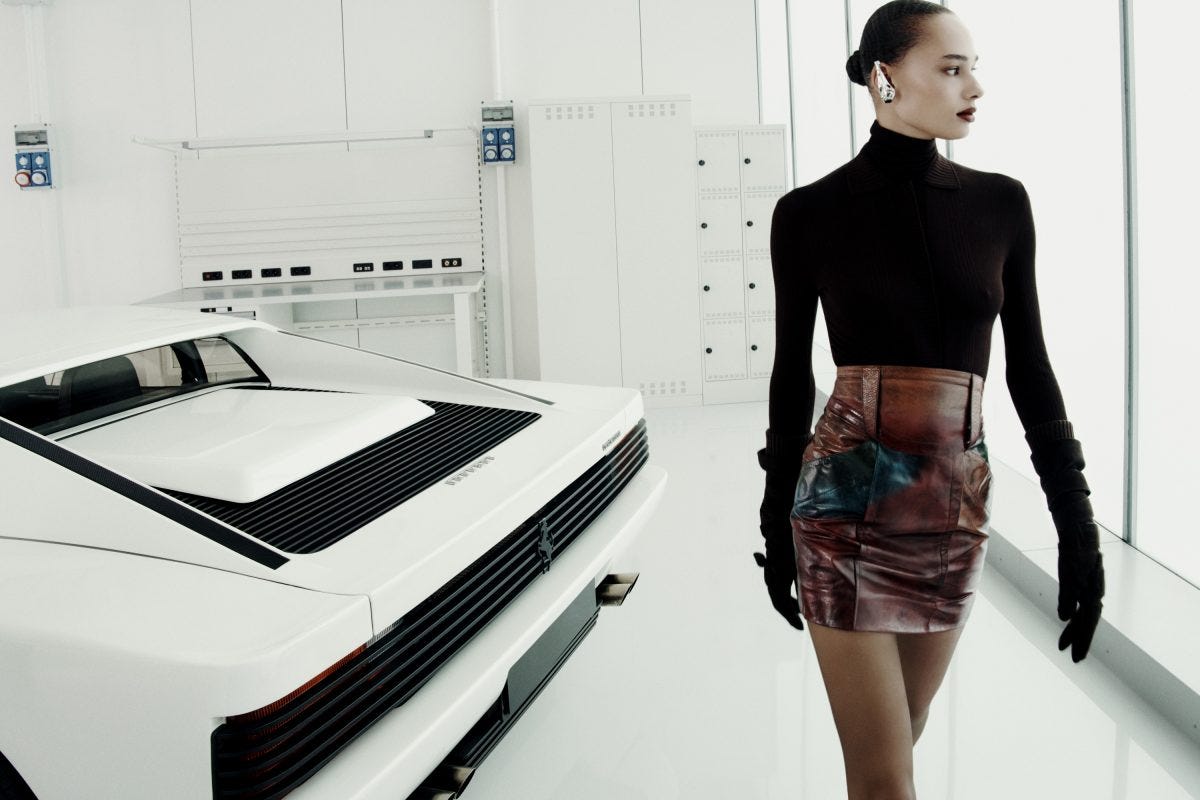
Yes, there is. Leverage the emotional pull of Ferrarieri’s most desirable cars—an iconic heritage that only Ferrari has access to—and place them at the top of the Ferrari value pyramid. Then, build a world of products around them that the target audience always wants more of e.g. seasonal fashion collections, fragrances, etc.
As you can see in the images below, it’s not new Ferraris selling the clothes, shoes, handbags and sunglasses.
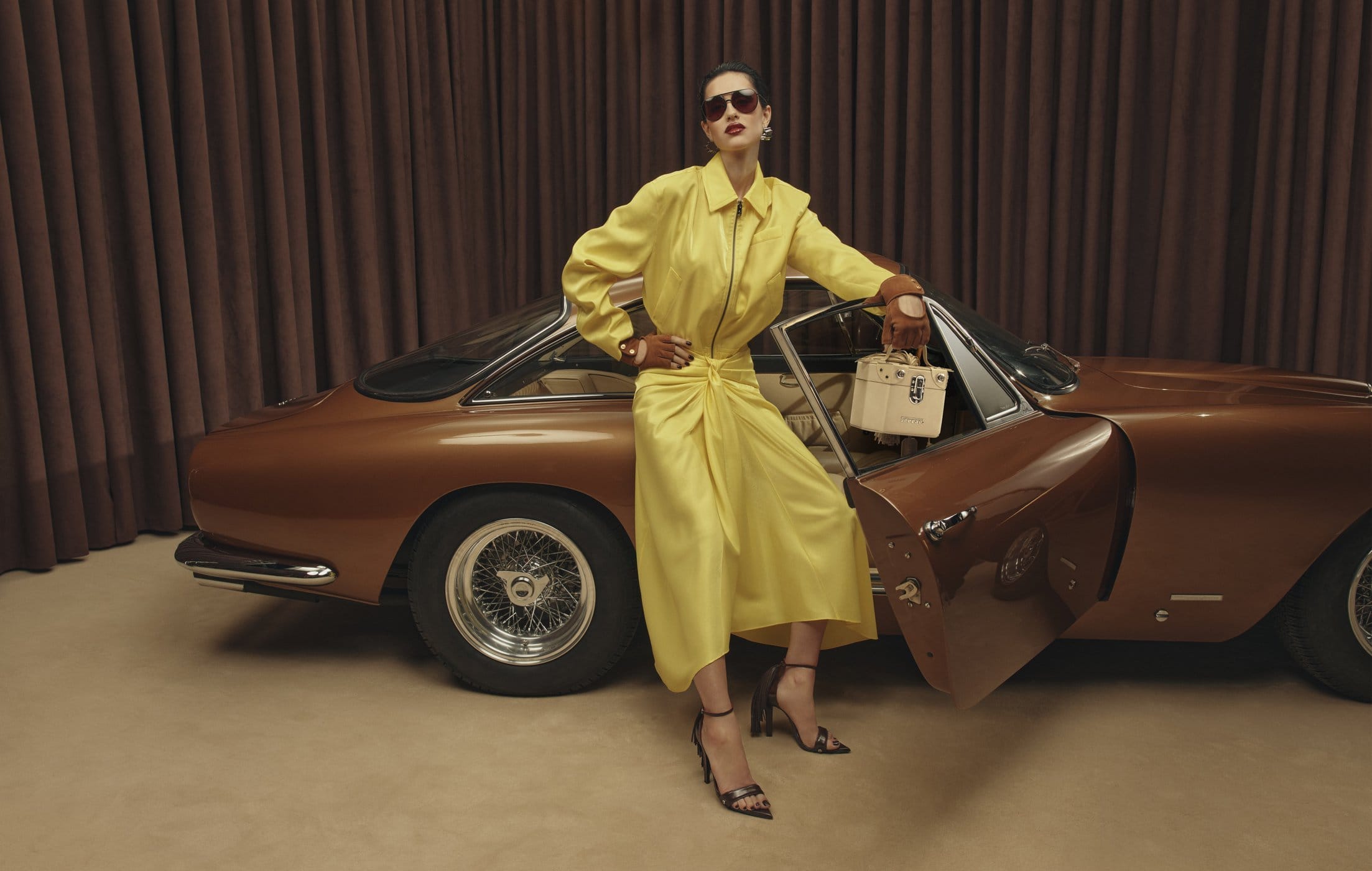
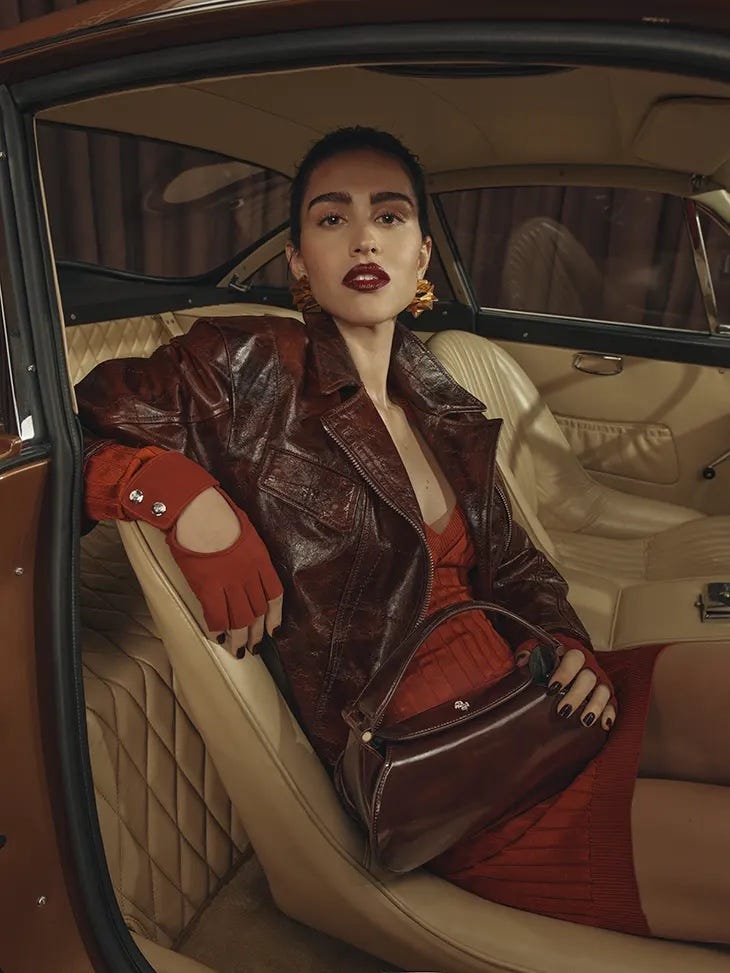
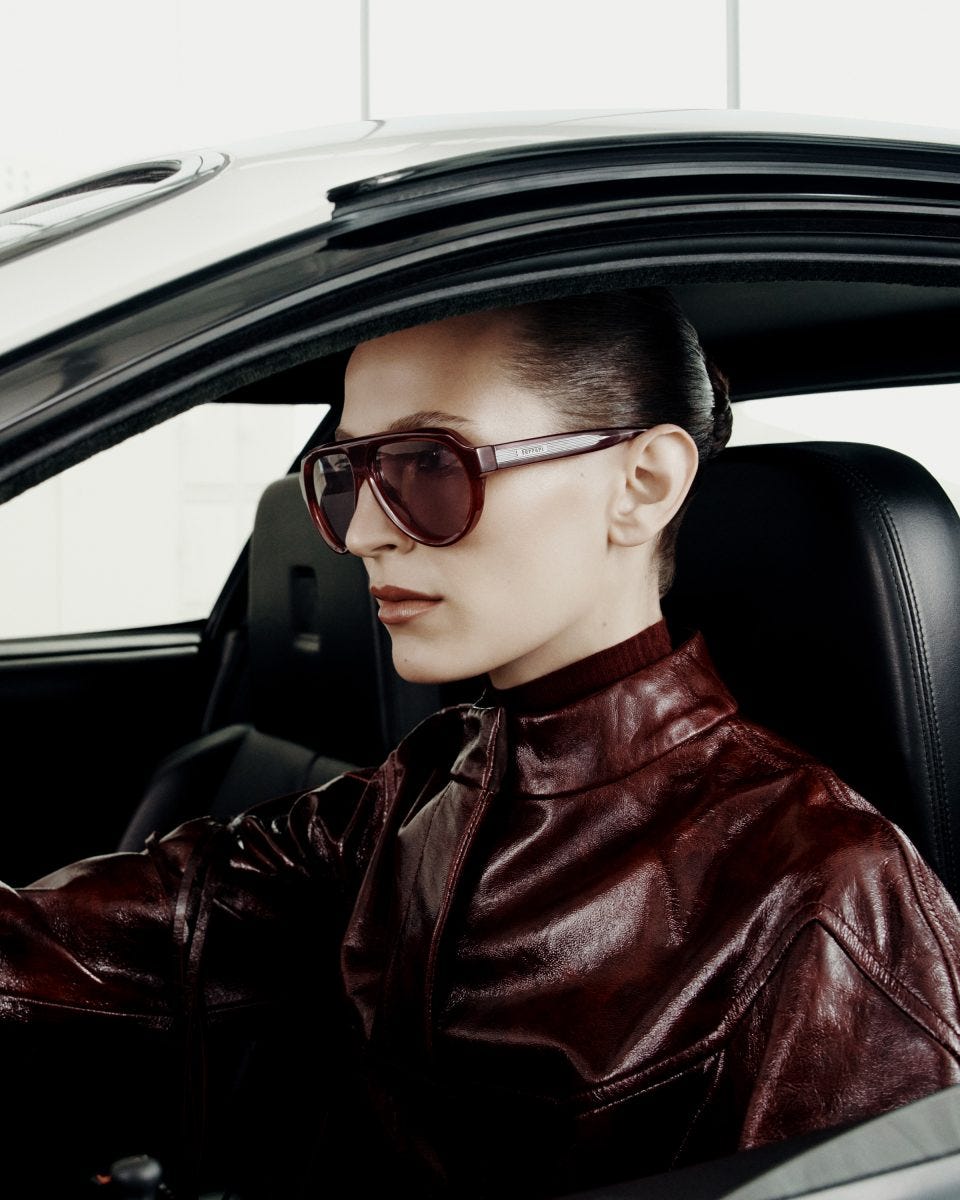
So, now that we’ve rationalised the category extension for Ferrari, let’s look at category extensions for a minute.
5. Category extensions
Many years ago, I used to work for Severin Wunderman, who owned Corum, the Swiss timepieces brand. Before buying Corum, Severin owned the licence to make Gucci timepieces. He bought the licence from Gucci in 1972 for less than a million, and sold it back to Gucci Group (who I’ve also worked for) in the mid-90s, for roughly $300 million.
Now, the reason Aldo Gucci sold the timepieces for less than a million is simple: he didn’t think it was worth very much. How many people would realistically buy a watch from a company known for its shoes and handbags?
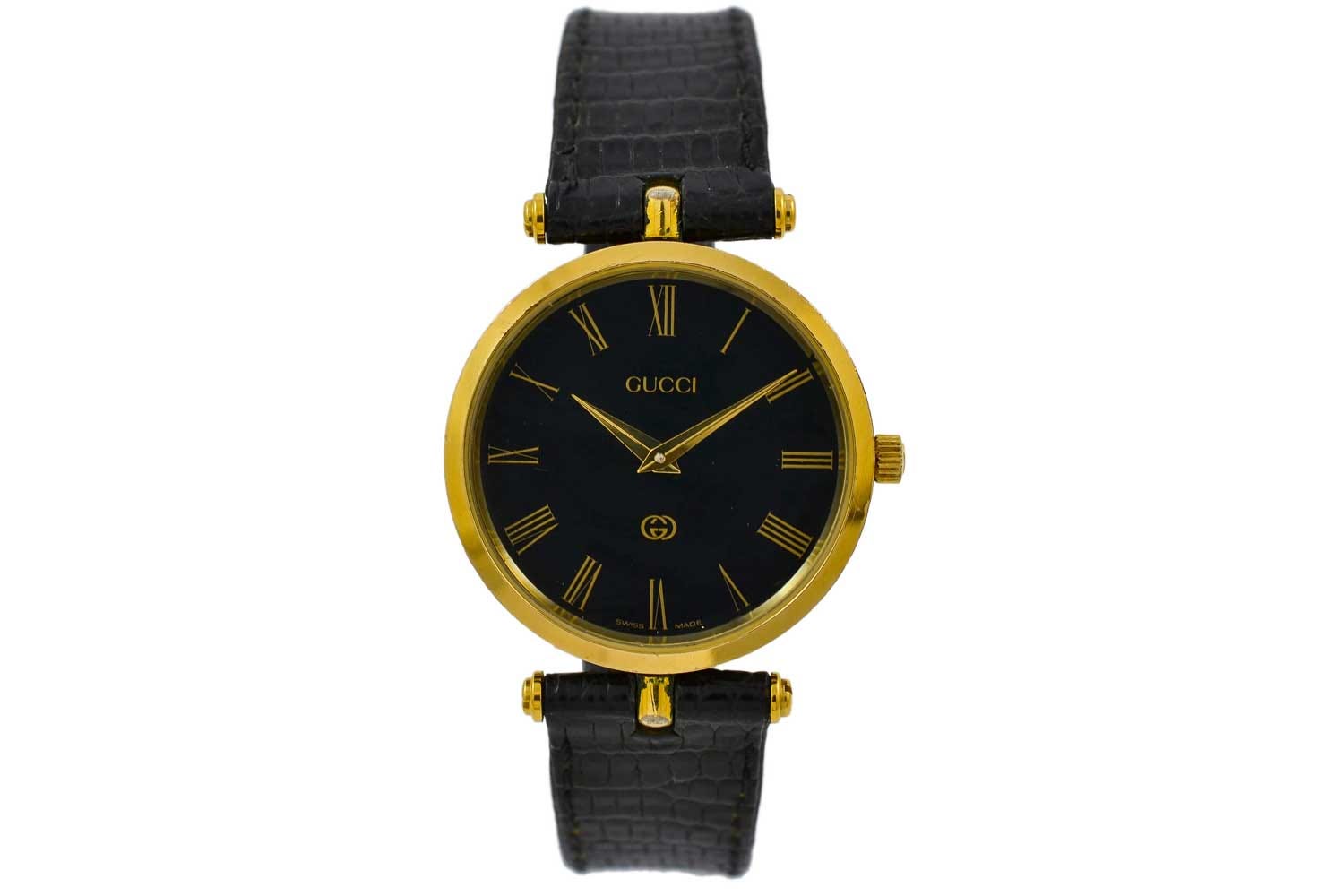
The answer, as it turned out, was “a lot”. In 1974, the Gucci Model 2000 broke the Guinness world record for bestselling watch, ever.
It’s a question that touches on what we’re going to discuss in a minute: how many people would buy a car from a company known for its shoes and handbags?
My answer is “a lot”. A Gucci car would break the world record for bestselling car.
But I’m getting ahead of myself…
Aldo Gucci clearly thought there would be a market for Gucci timepieces, but he didn’t imagine it’d be as big as it ended up being. He pre-ordered a lot of watches from Severin to sell in the Gucci stores themselves. In fact, the cheque he signed for his pre-order was bigger than the price Severin paid him to buy the licence. But the reason that cheque was bigger is simple: he just didn’t see much value being given away in the licence. Nobody then—not even Aldo Gucci—could have imagined that Gucci would have to pay $300 million to buy it back 25 years later.
The question, then, is: how far can category extensions go?
Well, imagine a category Nike hasn’t entered yet, like hotels. With a brand concept like “Just Do It”, we know exactly what a Nike hotel would look like and what we could expect from it, don’t we? The gym would take centre stage. You’d stay at the hotel for the training camps. The best rooms would have a view of a running track, where you’d see Olympic athletes training in the morning.
There is clearly a lot that can still be done in category extensions…
6. A “quartz movement” for cars
What would have to change for lifestyle brands to extend into cars?
Well, what has stopped them from extending into cars so far?
The answer: making cars is very difficult. It’s generally considered near-impossible for non-car brands to enter the market. Even Apple, a company full of competent engineers, tried it and failed to make the numbers work for them.
My contention is that this era is over. The car world is entering a similar situation as the watch world did when quartz movements blew everyone out of the water.
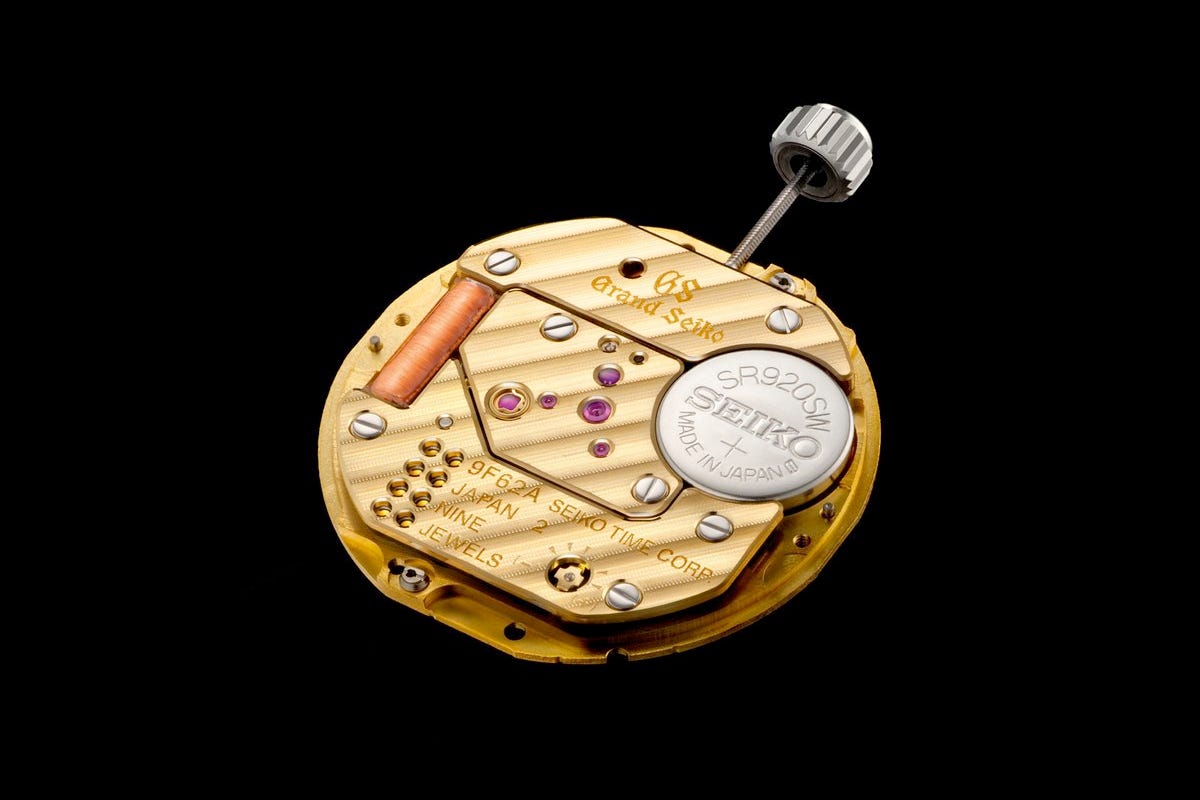
The moment quartz appeared in the watch industry, the game was up: any watch could keep accurate time forever, easily and affordably. Problem solved. The holy grail of seeking ever better performance became irrelevant overnight.
The Swiss called it the “quartz crisis”, because most players in the sector spent 20 years in the red while they tried to figure out what to do about the fact that a $10 Seiko could tell the time more accurately than a $1,000 Swiss watch.
This massive disruption enabled any lifestyle brand from outside the watch sector to enter the sector, launching watches just like they launched shirts, bags or shoes. Nike and Armani’s watches, for example, use quartz. Most Gucci watches use quartz.
And the reason lifestyle brands did that is because they knew something that watch people apparently did not: nobody buys a $1,000 watch to tell the time.
The same will, I believe, happen to the car industry. On the one side will be the luxury car brands we all know. On the other side will be cars launched by brands like, say, Nike, or Armani, or Gucci.
So, in light of all this, we can see Ferrari’s big problem coming up on the horizon. It’s the entry of lifestyle brands into the car market. Companies known for their shoes and handbags entering the car sector, just like they entered the watch sector 50 years ago.
7. The end is nigh (for some)
Why do I believe this will happen? Because we have seen the first symptoms of this change already: Xiaomi—a smartphone and electronics company—built the SU7, an affordable electric car.
It’s a really good car in terms of performance: 0 to 100 in 3.1 seconds! We’re talking Ferrari Purosangue performance at 1/10th of the price. And you get a great driving experience, enhanced by great technology (as you’d expect from a technology company...).
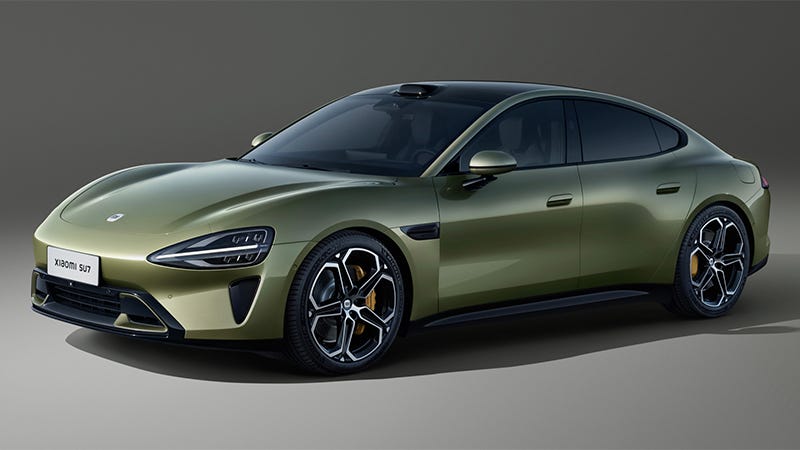
Now, you can argue the SU7 copied its looks from McLaren, Porsche and Mercedes, but that’s precisely what puts Xiaomi into a favourable position for what’s coming next: producing cars with a partnering lifestyle brand. Xiaomi will be the Severin of Gucci Automobiles. Or if Gucci won’t play, imagine Xiaomi producing a car with Nike, with a uniquely Nike-like approach to the way it looks and performs.
The first lifestyle brand to do it will have the same effect on the market as Edmund Hillary and Tenzing Norgay had on Mount Everest: signalling to the world that it could be done.
The moment this happens, two things will follow:
1. some car brands will collapse, because the only thing they could offer is something you can get from any EV. Just like quartz made us realise people don’t really buy a luxury watch to tell the time, so EVs will make us realise people don’t really buy a luxury car to go from 0 to 100 in 3 seconds.
2. other car brands will survive and prosper, the same way Cartier, Rolex, Patek and Tiffany survived and prospered after the quartz crisis. They’re the ones with a clear and resonant expression of a brand concept you’re buying into.
We see the latter most clearly in a brand like Rolex: a clear and resonant brand concept: “success”. You see it in the latest slogan (”Reach for the crown”), you hear it in the podcasts, where every guest they have talks about their road to success. Rolex has spent 70 years cultivating this concept into a culture. And it shows.
8. Conclusion
So, where does this leave us with Ferrari?
We’re going to hear a lot of noise when the Luce is launched. Armchair generals telling us the brand is dead because it’s an electric car, or because Jony Ive designed the interior and it looks like an iPhone, or because Marc Newson designed the exterior and, oh, he’s not a car designer. Never mind that one of the 20th century’s most desirable cars—the Citroën DS—wasn’t designed by a car designer either. Flaminio Bertoni was a sculptor.
Ultimately, the thing you have to do is transcend all the short-termist noise, transcend all the change and, echoing Jeff Bezos, ask yourself: what are the things that are not going to change in the next few decades? Since we mentioned Rolex, they’re actually a good example of this: one thing that is not going to change is people’s desire to express success. Whether they do that with an Oysterquartz or an Oyster Perpetual is almost irrelevant, as long as that specific desire is expressed through it.
Among the “things that are not going to change” is one thing that Ferrari has in spades. It will make all the difference and that nobody seems to be talking about very much.
Ferrari have been here before.
It’s somewhat known among Ferrari enthusiasts that Enzo Ferrari didn’t really care much about road cars. He only built road cars to pay for his real passion: racing.
The racing wasn’t paying for itself, but there seemed to be plenty of wealthy people willing to buy really fast road cars... which, when you’ve got a team of amazing engineers who can build the fastest racing cars in the world, isn’t that difficult to do.
Viewed from this perspective, Ferrari is not a “business”. It’s more of an obsession in search of a way to pay for itself. And that obsession is something Enzo Ferrari had so much that he infected everyone working for him with it.
If you think about it, that’s the most authentic way you can imagine a brand concept trickling down into a culture, which then forges the point of view we spoke about at the beginning of this essay. The products are merely by-products of this point of view.
Ferrari spent 70 years cultivating this obsession into cars that make customers believe they’ve found something better than sex. And, just like the road cars were a way for Enzo Ferrari to pay for that obsession, Ferrari have now found a way to continue paying for that obsession by launching a world of desirable products around it. As long as that obsession itself exists in the customers, as long as they see that part of themselves expressed through the brand, Ferrari will be just fine.