


A king, a priest, and a rich man are sitting in a bar. No, wait, that sounds like the opening line for a joke. Let’s turn it into a riddle; this is a serious essay, after all... OK, next to the three men stands a common soldier holding a sword. Each of the three men orders the soldier to kill the other two. Who lives? Who dies?
This riddle sounds like a question about force. Your first answer might be that it’s up to the soldier: he’s the one with the sword! He has the ability to turn theory into bloodstains, so to speak.
But if the power lay in the hands of the soldier, why would any of these men even expect obedience from him? If power truly belonged to whoever could kill, history would be a chaotic list of angry-looking people holding pointy things.
Instead, soldiers obey kings who can’t pay, priests who can’t command, and rich men who can’t fight. They do this every day without needing to be physically forced.
Which means the sword isn’t the source of power. The sword is just a tool.
The king’s authority exists because people believe in the crown. The priest’s authority exists because people believe in divinity. The rich man’s authority exists because people believe in money.
None of these forces are tangible. You can’t stab someone with legitimacy. You can’t bludgeon someone with faith. And yet these forces routinely override the sword.
The upshot is this: power lives neither in the person giving the order, nor in the hand holding the weapon. Power lives in the shared belief that the order matters. The soldier obeys not because he must, but because he believes he should. Because the world has trained him to recognize certain voices as authoritative.
So, power is an agreement rehearsed so often that it just feels natural. In the words of Nike, you “just do it”.
One way to visualise this is that power is a shadow on a wall. It looks solid. It has shape and reach. But try to touch it and there’s nothing there. The shadow exists only because something else is casting it. Change the light and you change the shadow. In other words, control belief, and you control power. Shape what people accept as normal, legitimate, inevitable, and you don’t need the sword at all.
So, the riddle we started this essay with is not asking who is strongest. It’s asking who cultivates the illusion. Power survives only as long as people continue to believe in the rules of the game. The moment that belief fractures, a crown become just another hat, gold becomes just another metal, and a Bible becomes just another book.
Now, with that foundation in place, let’s talk about nations.
A nation is not a flag, an anthem, or a constitution. Those are accessories. A nation is a large-scale agreement between strangers who’ve never met each other to believe they belong to the same group. Benedict Anderson used to call them “imagined communities”.
Which makes nations some of the most powerful brands ever created.
If Nike somehow convinced millions of people to speak Nikish, to run to work every morning, to dress in tracksuits like it was a folkloric dress, to sing the “Just do it” anthem every year on 25 January (the day the company was founded), to feel emotional loyalty to the Swoosh, we wouldn’t call it a marketing miracle; we’d call it a geopolitical event.
Nations do exactly this, using language, food, myths, folkloric clothing, songs, and the occasional war to really drive the point home.
Nation branding, whether intentional or accidental, is about managing belief. About tending the light source that keeps the “power shadow” on the wall. The most successful nations aren’t the ones with the biggest swords. They’re the ones with the most convincing brands.
Germany is a useful example because its national narrative had to be assembled before the nation itself fully existed. Prior to unification, “Germany” was more of a vibe than a state: fragmented territories, competing loyalties, dialects that barely recognised one another. You couldn’t command “the Germans” because they hadn’t yet agreed they were a single thing.
What did exist were stories, dirndls, folk songs, legends that felt ancient and meaningful even when the borders were not. The Brothers Grimm didn’t invent folk tales; they curated them at exactly the moment they were needed. Their collections emerged in the early nineteenth century, alongside growing movements toward unification. Suddenly, people across different regions recognized the same characters, the same moral logic, the same symbolic landscapes.
So, before there could be political unity, there had to be narrative unity. A shared emotional vocabulary. Germany’s “power shadow” began forming long before there was a single crown to cast it. The belief came first; the borders followed.
Italy offers an even clearer case, mostly because one of its architects said it out loud. After unification, Massimo d’Azeglio remarked, “Italy has been made; now we must make Italians.”
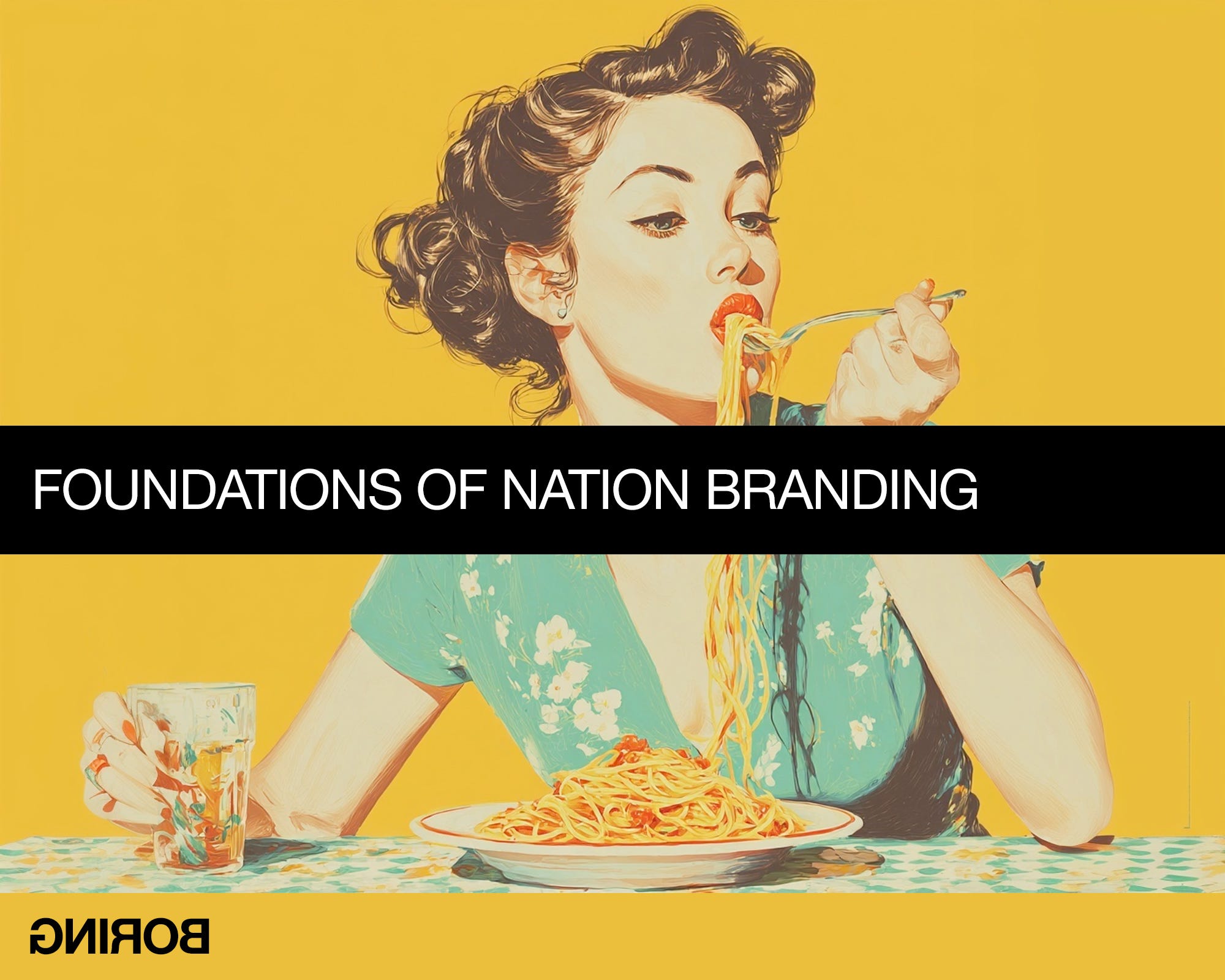
Italy wasn’t lacking history. It was drowning in it. What it lacked was a shared daily experience that could override regional identities. Enter food, the most persuasive cultural technology humanity has ever invented. You can ignore a flag. You can disagree with a speech. It’s much harder to reject dinner.
Pellegrino Artusi’s Science in the Kitchen and the Art of Eating Well did more for Italian identity than most political campaigns. By collecting regional recipes and presenting them as Italian, Artusi offered citizens a visceral brand experience of what it meant to be Italian. An experience they would have every day, with every meal.
This is how nation branding works when it works: not through slogans, but through experiential habits. Belief settles in, meal after meal, folk song after folk song, national holiday after national holiday. Pretty soon, you just can’t imagine things existing any other way.
Modern nation brand directors and culture ministries often forget this. They commission logos, taglines, glossy campaigns announcing identity as if identity were a product launch. “A nation led by innovation”. “A crossroads of cultures”. “A bridge between East and West”. These are not nation brand concepts; they’re placeholders. They cast weak shadows on the wall because the light behind them is thin.
The strongest nation brands don’t announce themselves as brands. They feel inevitable and natural, like they’ve always been there. That’s the illusion, and it’s a powerful one: when belief is doing its job, power doesn’t even have to explain itself.
This also explains why nations panic when belief starts to wobble. Because belief is fragile, challenged by economic collapse, cultural contradiction, political corruption, ... Remember: change the light source, and the shadow changes. Symbols that once felt sacred start to feel theatrical. Traditions feel “marketed”. The audience notices the wires.
And once belief cracks, force rarely fixes it. You can’t threaten people into genuine belonging. You can only make them comply until they stop believing altogether.
So, the final point to make about it is this: no one ever fully controls belief. You can shape it, nurture it, protect it, but the moment people feel they are being told what to believe, the illusion weakens. Power survives longest when it pretends not to be trying, when it behaves with the political equivalent of sprezzatura.
That’s why nations endure not because they are strong, but because their brand is convincing. Because their “power shadow” looks so natural against the wall that people forget there is a light source at all.