

Do the unmeasurable
On the opportunity for asymmetric warfare in your start-up's marketing strategy.

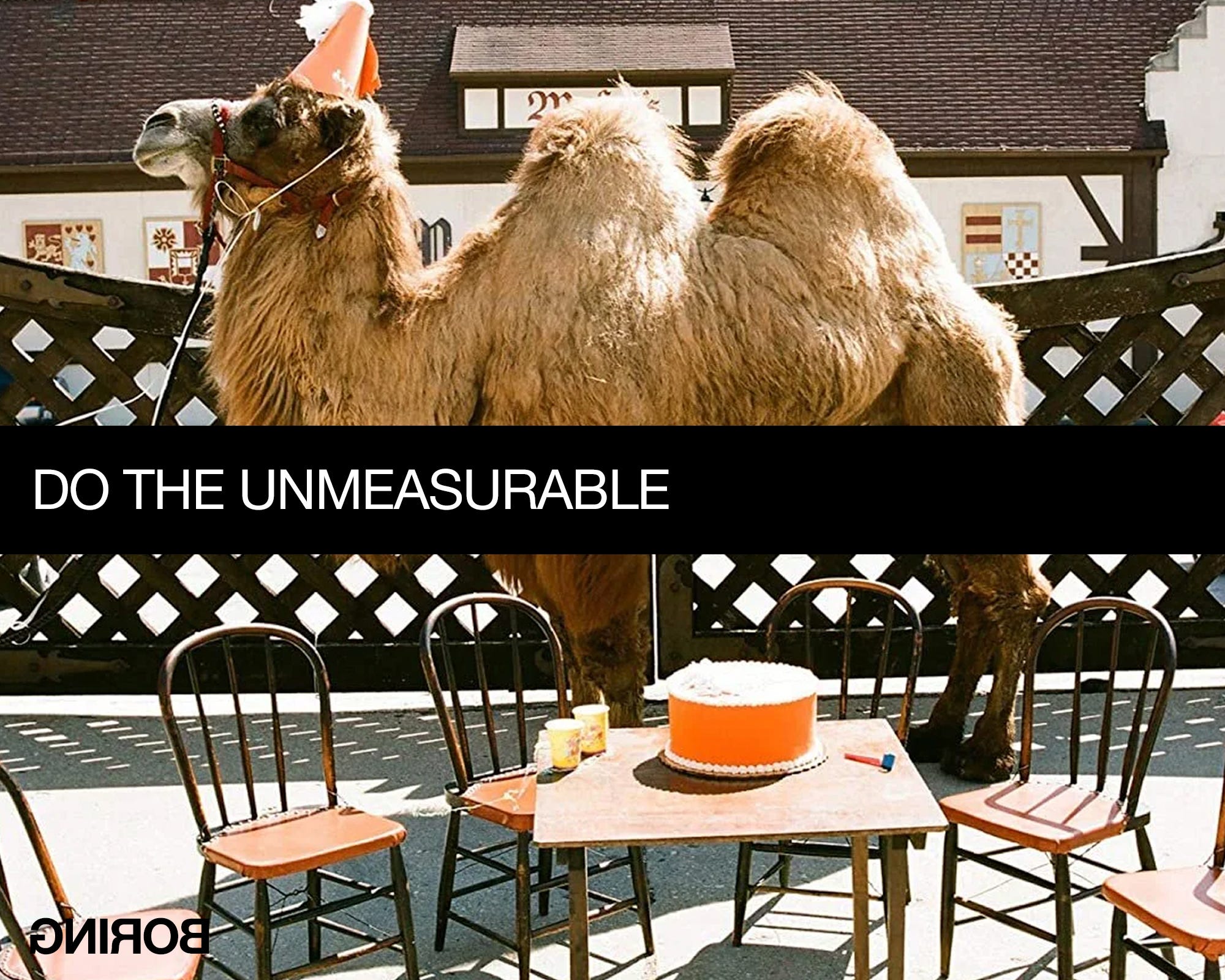
I was recently invited into a start-up’s pitch when, near the end of the presentation, the founders started going through the numbers, which—as you’d imagine—lead to lots of doubts and disagreements from most of the investors, until the most respected of them asked everyone to just shut up about the numbers and go back to discuss the concept.
I was really happy he did that because, in my experience, a start-up’s numbers don’t really tell you anything. Whether it’s going to have one hump or two, it’s going to be a big animal and that’s all that matters at this point.
So, to get into this mindset, let’s imagine an investor trying to estimate the value of two companies ten years from now.
On one side, they have a large, established business with decades of spreadsheets, book value, EBITDA, free cash flow, dashboards, charts, committees, subcommittees, and several people whose only purpose is forwarding PDFs.
On the other side, they have you: a start-up with very little historical data, but a brilliant product and a lively community of genuine fans who can’t stop talking about them.
Which company will be worth more in ten years? If you’re focusing on numbers, there’s no way to tell. Because all the numbers the big company as describe the past. There’s no numbers for the future. That’s what makes it the future.
That, right there, is your start-up’s advantage.
Large corporations are forced to work with measurable inputs and outputs. Every pound a marketing director spends must eventually be translated into a tidy performance metric to justify their continued access to oxygen. So, they rely on what happened yesterday to decide what to do tomorrow.
This is their weakness: they’re driving full speed into the future while staring into the rear-view mirror.
Meanwhile, as a start-up, you have the rare privilege of not being trapped by metrics at every turn. You barely have a dashboard, you don’t even have doors, never mind a rear-view mirror!
Good. That means you can focus on what’s actually in front of you.
You can feel this difference most clearly in how big companies approach “community”. They build loyalty with offers. Join our members club for exclusive access to seasonal promotions and selected discounts! Because, clearly, nothing ignites human passion quite like selected discounts. You can almost hear the quarterly presentation: “Engagement rose 14% after we gave away a tote bag.”
It’s a fake community because they’re measuring the wrong things to begin with. Small companies that understand themselves don’t need discounts to create fans.
Think back to the bands you loved as a teenager. Why did you love them? Was it because they offered 10% off merchandise for newsletter subscribers?
Of course not. You loved them because the music sounded like your private thoughts. Because the singer looked impossibly cool brushing hair from their eyes while insulting an interviewer. Because someone you fancied loved them first. Because they came from a city you romanticised. Because they represented a version of life that felt different and alluring.
Notice something important: none of that was measurable. No spreadsheet can quantify longing, identity, belonging, taste, obsession, or wanting to become the sort of person who listens to that band. And yet those forces move markets every day.
The music industry has always understood this better than most. That’s why A&R people work the way they do: they’re not hunting balance sheets, they’re hunting electricity. They know the odds of finding the next Lady Gaga are absurdly small. But if they can find that strange, magnetic force that makes fans rally around artists like Wilco, Pavement, or Röyksopp, they’ll find something far more valuable than a quarterly spike: durable affection. And, in today’s world, a tiny label with taste can spot that just as well as a giant corporation.
This brings us to another beautiful feature of the unmeasurable: it creates the perfect conditions for asymmetric warfare.
As a start-up, getting people to love you is possible You can be personal. Distinctive. Slightly weird. Intensely thoughtful. Generous in ways that don’t fit neatly into reporting software. You can become the brand people feel clever for discovering.
Big companies struggle with this. They can absolutely buy awareness, but love is ruinously expensive when purchased through campaign budgets and approval chains. Before they can attempt anything interesting, someone needs forecasts, benchmarks, ROI models, stakeholder sign-off, legal review, and Trevor from Finance asking if whimsy can be depreciated. By then, the moment is gone.
So, use your advantage. Do the thing that can’t be easily measured, copied, or approved in triplicate. Create the atmosphere, identity, taste, intimacy, or devotion that large companies can’t manufacture without spending millions trying to imitate what came naturally to you. Make that thing the reason people buy from you in the first place, and watch the big corporations spend billions trying unsuccessfully to replicate it while you ride your wave to success.
PS: speaking of unmeasurables, did you know GNIROB was free?