


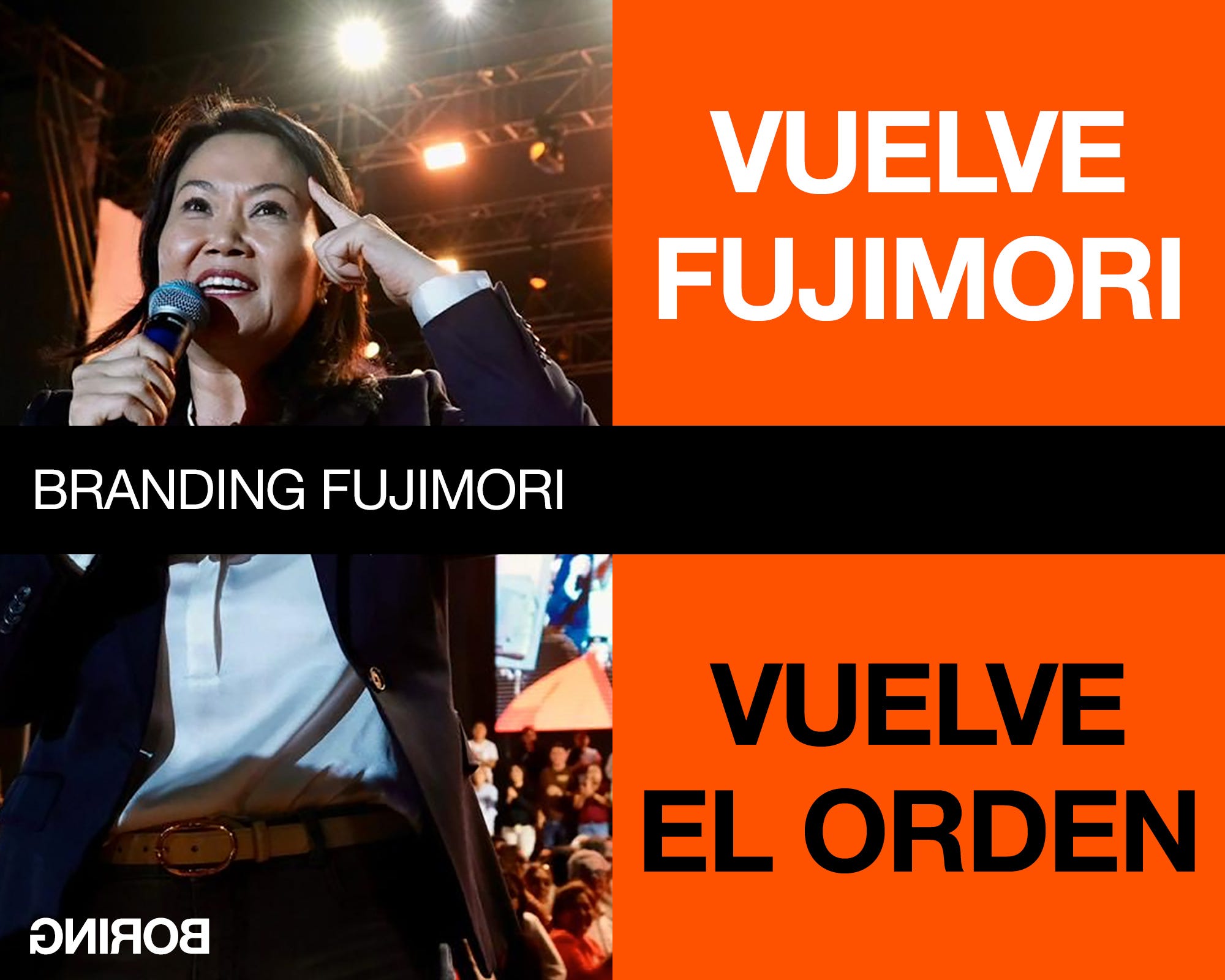
A few weeks ago, I wrote a short essay on LinkedIn outlining why I believed Keiko Fujimori—despite having failed three times to get elected in the past—was now in the best position to win the presidential elections. My theory was entirely based on the fact that, where her messaging used to be somewhat scattered and improvised, we now had a very tight, very focused, and very emotionally resonant concept to work as the foundation for every message, regardless of the situation at hand.
I briefly referenced this short essay in last week’s essay on how the Leave side won the Brexit referendum 10 years ago, because the brand concept was structured in the same way. While I had nothing to do with the Brexit referendum, the way the Leave campaign was structured around a simple concept is very similar to how I have been developing campaigns over the past 30 years.
Keiko has now won the elections, and building brands to win is ultimately what GNIROB is all about, so let’s re-visit that essay.
Lima, 10 June 2026.
Before we start this essay, I’ll warn you that I am a terrible predictor of election results. You should not take my election predictions seriously.
I think this is partly because a big part of my job is developing brand strategy, and in the process of doing that, my role is often to reframe complex propositions into very simple concepts. But political systems are and remain immensely complex, with millions of extremely divergent actors working out their subjective values into a binary electoral result.
In other words, there is no lens you can use that simplifies the dynamics at hand into a predictable scenario. Which is a pretty weird thing, if you think about it: given the radically different impact for so many people, it’s baffling how a categorical win is sometimes determined by the smallest majority. In the current Peruvian elections, the majority will be something around 20,000 votes either way. Hair thin.
So, what I’m going to talk about instead, is the reason why I believe Keiko Fujimori has the best possible brand strategy of any candidate in Peru’s presidential elections.
Whether this then translates into her winning this current election is anyone’s guess. But if she doesn’t get over the line, we can discuss some of the reasons why—even though her campaign is very good—it may not be enough.
As most of my readers will know by now, my general modus operandi in brand strategy is to put all efforts and resources into owning a tiny bit of real estate in the consumer’s mind—a single brand concept—which is then emotionally augmented to such a degree that consumers believe it to be the most important value when they’re thinking about the category. In other words, we want to own a category entry point.
So, a few examples:
If you’re emotionally engaged with the idea that your next car should be safe (maybe you’ve got a family to protect) then Volvo’s long-standing connection to this category entry point will lead you to the natural conclusion that you should book a test drive with them.
If you’re emotionally engaged with the idea that a courier should not lose a package you want to send (maybe it’s your grandfather’s will), then UPS’s long-standing connection to this category entry point will lead you to the natural conclusion you should book a collection with them.
If you’re emotionally engaged with the idea that a watch should express success (maybe it’s what you’ve been working towards for the past decade), then Rolex’s long-standing connection to this category entry point will lead you to the natural conclusion you should “reach for the crown” as their slogan calls it.
So…
What is Keiko’s brand concept?
Simple: “order”.
It’s really as simple as that, and that’s the reason behind its power, because it’s a claim she can back up with an easily-communicated brand heritage. Keiko’s father turned Peru from a chaotic country on the verge of the abyss into a somewhat orderly country back in the ‘90s.
Alberto Fujimori was voted in after twenty years of economic mismanagement that culminated in not one but two bouts of hyperinflation, by a country that was almost taken over by the Sendero Luminoso’s Maoist terrorists, who were literally bombing entire neighbourhoods of Lima off the map. His legacy is two-fold:
1. He oversaw the rescue operation of one of history’s biggest hostage situations, in which over 500 people were taken hostage by MRTA terrorists at the Japanese embassy in Lima. After a 120-day siege, the rescue operation was, well, spectacular: “only” one hostage died on the way to the military hospital, and two army officers who are now national heroes. With this operation, Fujimori managed to breathe new energy into the fight against terrorism that eventually saw the capture of Abimael Guzman and the dissolution of both the MRTA and the Sendero Luminoso.
2. He managed to create a new, independent central bank whose currency has been the most stable in Latin America for just over 30 years now. Even during the crisis of 2008, Peru’s economy remained very ordered and very stable. The fact that Peru has been growing so much over the past 25 years despite the country’s political instability is largely attributable to this, and to its by-product: the depoliticization of economic activity.
Now for the second part:
How do you make such a simple proposition emotionally resonant?
Again, simple: nostalgia.
Many Peruvians are unhappy with the situation right now: Lima has fallen to a different kind of terrorism. The mafia gangs from Venezuela. The extortionists. The sicarios. The cocaine producers from the VRAEM regions.
There is a deep desire for the kind of order that people from Europe take for granted, and it’s made all the more powerful because it wasn’t that long ago that people felt the joy of coming out of such chaotic times and of building a positive future for their children.
Arguably, the word “Again” is the most powerful in the “Make America Great Again” slogan that won Donald Trump the election, precisely because it evokes that nostalgia. The same goes for the word “Back” in the “Take Back Control” slogan that won the Brexiteers their majority. It’s nostalgia.
In Keiko’s case, that word is “Vuelve”: order returns. It’s a much stronger proposition, because it suggests that it is within reach—we used to have it. And it’s stronger because it evokes for many people the idea that things were better when they were younger. The fact that Keiko’s father has now passed away even works in our favour here: we can mythologise him and apply a similar relationship to his concept as you might relate to with, say, “Return of the Jedi”.
Once you see this connection with such an archetypal story, all kinds of lights will shine brightly in your mind, because Keiko’s victory feels as inevitable as the ending in every myth humans have been writing down for the past 3,000 years.
Now, great as this all feels, there is still one aspect that may just undo its power: while an electoral candidate might have a fantastic brand concept for a coming election, true brand power comes from many years of embodying a single value in the mind of the consumer (or citizen, in this case).
We mentioned Volvo earlier: Volvo have spent the best part of 50 years talking about just one thing: “safety”. You need this kind of long-term concept to forge a mnemonic path in the mind of the individual, so that their desire for safety would translate almost automatically into a desire for a Volvo car.
By contrast, political campaigns are often strategized and implemented in the span of months. An election campaign is more like going back to the kind of film campaigns I used to work on for Twentieth Century Fox, Disney, Miramax, Buena Vista, etc: a film is coming out in a few months’ time, and we need everyone to want to go see it.
And so, in conclusion, I believe Keiko Fujimori has the best campaign Peru has ever had, but I think—if she doesn’t win—that the first thing to do would be not to give up, but simply continue with the same brand concept, day in day out, for the next five years.
There are no shortcuts to mnemonic pathways in the consumer’s / citizen’s mind. As much as a company or candidate mirrors a certain desire they have through a clear and emotional brand concept, what is really needed is a longer-term mindset that allows this concept to grow and bear fruit over many years.