


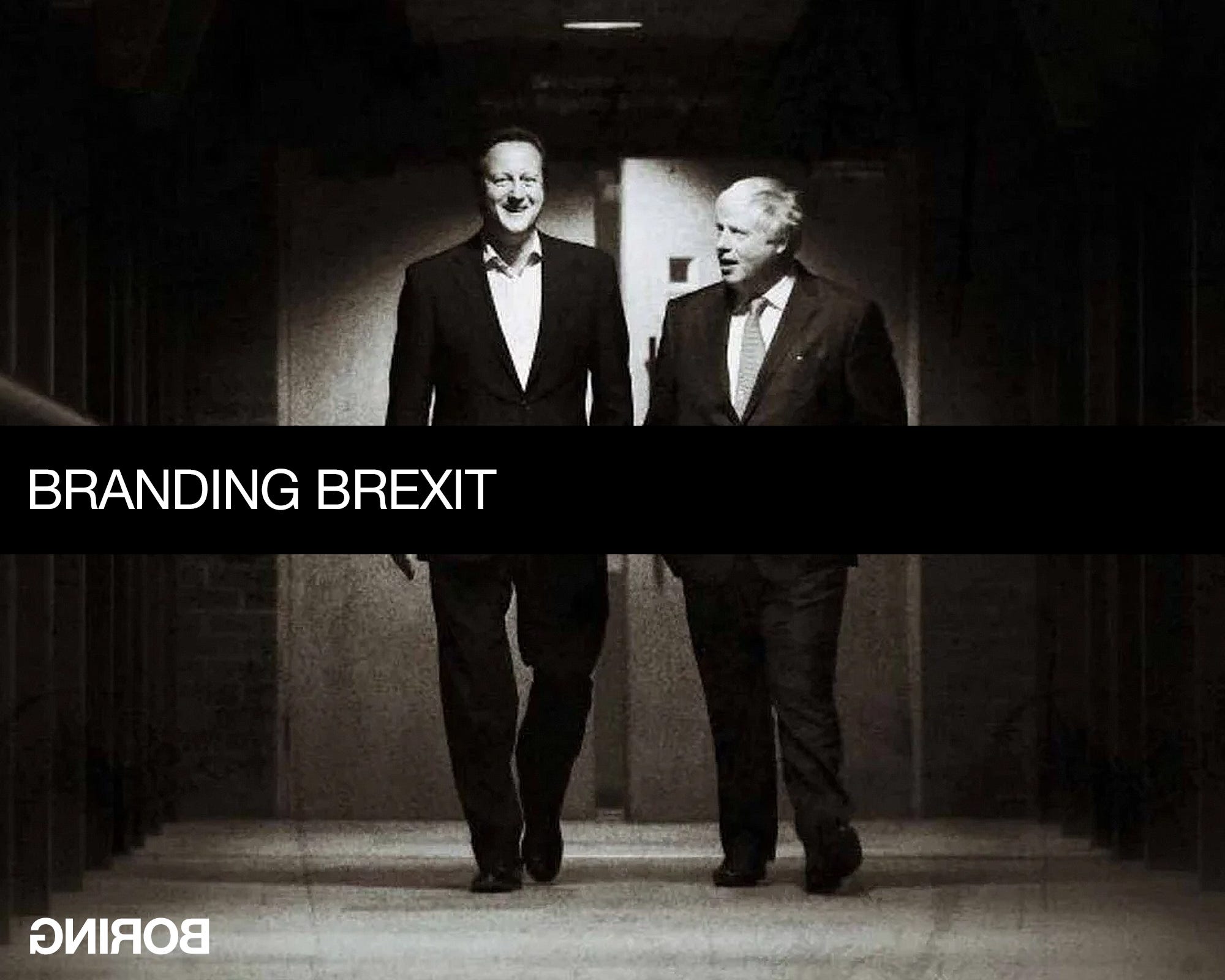
Last week, I read a number of articles written on the occasion of the Brexit Referendum’s 10-year anniversary. One thing that struck me, was that nearly every article on the subject seemed attached to the idea of somehow unbreaking a broken glass, i.e., going against the entropy that is contained within the world, rather than studying how these phenomena are created in the first place.
So, with the benefit of 10 years’ worth of similar projects taking root in other countries, let’s take a closer look at the subject from a brand strategy point of view.
The first thing to note is that the Leave side won the vote contrary to all the official polls, contrary to nearly all political and economic forecasts, triggering the United Kingdom to leave the EU, one of the world’s largest and most powerful institutions.
How did they do it?
The answer is simple: selling a political position is no more about the numbers than selling a puppy. If I show you a puppy, do I need to tell you about the economic benefits of having the puppy? Do I need to present you some charts, perhaps? Some statistics and forecasts? In short, some numbers?
Of course not. Well now, you understand something really simple: Leave won by focusing on the opposite of numbers: the unmeasurables.
To really “get” this, we have to look first of all, not at what Leave did, but at what Remain did. So, look at the kind of campaign the Remain side held. They focused almost entirely on the numbers. The entire Remain campaign was focused on things like the GDP and the estimated number of points the UK’s economy wasn’t going to grow by if they left the EU.
And what’s interesting is that the Remain side’s articles are still focused on those numbers: the Remain side still believe the campaign was won on numbers, but that the Leave side lied about them. Last week, I saw a number of articles argue that Leave won because of the controversial “£350 million a week” bus advert.
Say what you like about the bus advert, to argue Leave won because of it is a terrible mistake. The Leave campaign didn’t win on numbers. In fact, they spent most of their efforts staying as far away from numbers as possible, because they were very clear on one thing: a decision like that isn’t about the numbers. Instead, they focused on strongly held principles. Emotionally held principles. Unmeasurable principles.
Leave won because of a strategy that focused on one simple proposition: “take back control”. For context, the EU had felt like a place that was out of control for almost a decade. The Eurozone alone was a complete basket case. Entire countries, whose credit had been guaranteed by their Eurozone membership, were bankrupt and driving tens of millions of people into unemployment. At the same time, we saw millions of people crossing the EU’s Eastern and Southern borders with Turkey and the Mediterranean, without anyone apparently being able to do anything about it.
This perceived incompetence of the Eurocrats felt like even more of a threat to the average Briton because, year after year, more and more control had been ceded to them, with more still to come.
Through a simple slogan, focusing on the word “back”—implying a return to a happier time when the British were masters of their own destiny—an emotionally resonant campaign gathered incredible momentum and won the game for Leave.
Let’s look at another, more recent political campaign that has worked on a similar dynamic.
I wrote an essay on LinkedIn a few weeks ago on the reasons why Keiko Fujimori was going to win the Peruvian elections by focusing on one simple concept: the return of order. Ever since Ollanta Humala—an ultra-left wing former army commander—won the elections in 2011, Peru has felt more and more like it’s descending into chaos.
And if there’s one thing Fujimori has, it’s a family legacy of establishing order. Her father spent most of the 90s shaping Peru back into a somewhat orderly country: defeating the Senderista terrorists and—following two of history’s most damaging bouts of hyperinflation—creating the most stable currency in Latin America.
By focusing on the one single concept everyone associates with the Fujimori name—order—and by leveraging the fact that she incarnates the “return” of order (she’s Fujimori’s daughter), she has managed to cultivate the desire for order through a deep sense of nostalgia, and won the elections as a result.
Now, you may argue that this isn’t how things should be. You may argue that it should be about the numbers. Perhaps, when we’re talking about very important decisions like leaving a massive political block, some other way of making decisions should be adopted that ensures sense triumphs over sensibility.
Let me offer you some examples to counter that argument.
First example. When Winston Churchill made his speeches during WW2, he didn’t say “we shall fight them on the beaches, and the UK will experience an estimated 5% economic growth”. The fight against the Nazis was not a fight about the numbers, but about good and evil, i.e., strongly held principles. Unmeasurables.
Second example. Decent people will likely never join the Ku Klux Klan, regardless of whether they reduce entry fees to their rallies, or whether they give members a 20% special discount at their local diner. Fees and special offers are meaningless, because you don’t support or reject an organisation like that based on anything other than strongly held principles. Unmeasurables.
So, now that we know how to sell the Leave case successfully, how should Remain have sold their case?
Well, much of the premise of the Leave campaign rested on the idea that they were the underdogs in the fight against the big, bad Eurocrats. The British do like to support the underdog.
But the British like something else even more: they like to win. And perhaps it takes a foreigner like myself to see it, but Britain, far from being the underdog in Europe, was actually winning the European game!
All you have to do is listen to the Brexit negotiations that took place between 2016 and 2020: they were all conducted in English. What kind of underdog gets 27 countries to hold their most valuable negotiations in the underdog’s language? In fact, if you’ve ever watched the debates in the European parliament, it surely won’t have escaped you that even front-row leaders like Guy Verhofstadt conduct all their speeches in English.
The English language completely dominates the European Union, and not just in the European institutions themselves. Companies across the continent conduct business in English. Universities lecture their students in English. The European experience, for almost every EU citizen, is an experience mediated in the English language. What the British failed to achieve in the 18th and 19th century was achieved so easily in the EU that they didn’t even notice.
I have often discussed languages in my essays, the way they create our sense of “Us”, the way they shape the mindset we conduct our lives in, the way they lead us to accept a certain reality by equating the symbol and the real thing. Prices increase, and we say that they “go up”, a simple metaphor that is so ingrained in the way we speak that it has become ingrained in the way we think. We get so used to it we don’t even see it, just like we don’t see the pixels on a screen anymore, only the pictures they represent.
Once you’re aware of this, there is only one conclusion you can draw: whoever controls the language, controls the mindset and everything that is a by-product of the mindset, including politics.
And this is perhaps the reason the Remain campaign didn’t see the immensely valuable gift that was right in front of their eyes: the idea that English should be the vehicular language across all of Europe was so normal to them, so banal, that it had become invisible to them. As a result, they didn’t see how it could be exploited, both in their actual relationship with the EU, and in their campaign advocating to continue the course and win the game.